
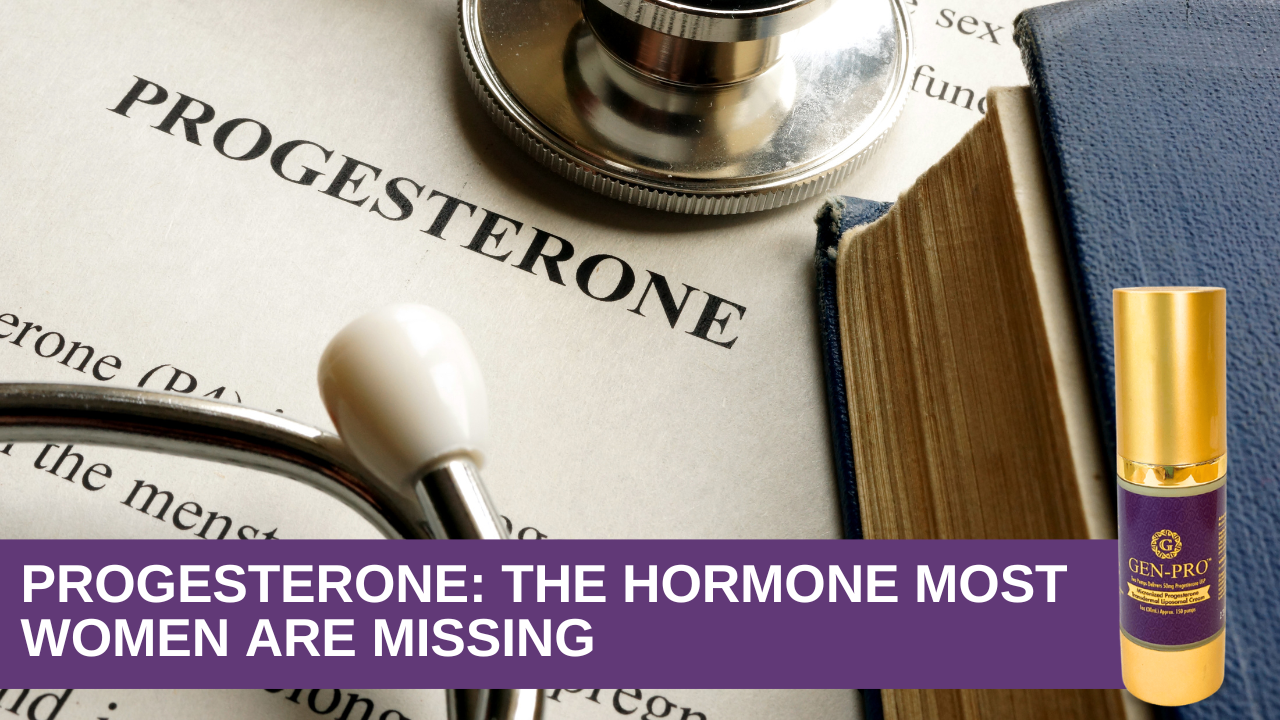
So why is progesterone important, and what's the best progesterone available?
Let's talk about it.
Progesterone is one of the most important hormones that your body makes, especially for women, but men also make a little bit of progesterone. Progesterone is the precursor to cortisol, your adrenal stress hormone. With 21 carbons, progesterone is one of the largest hormones, which is one of the reasons it is so difficult to get good absorption of progesterone through transdermal creams.
But I'm going to share with you a secret to the best bioidentical progesterone available.
Progesterone naturally has an anti-inflammatory effect. Progesterone stimulates calming GABA in the brain and nervous system. It calms the muscles, especially smooth muscles, which is why you might get a little constipated when you're pregnant, which is a very high progesterone state.
Progesterone's Role in Pregnancy
Progesterone has to be present at very high levels in order to maintain a pregnancy, and if you don't make enough progesterone, you're likely to miscarry.
Progesterone is produced by the ovarian corpus luteum, that little cave left over after an egg ovulates, for about two full weeks until the next menstrual cycle to maintain the lining of the uterus and prepare the body for potential pregnancy.
If pregnancy doesn't occur, the corpus luteum stops producing progesterone, and you have a period.
If pregnancy does occur, the corpus luteum's job is to continue to produce progesterone for the first 14 weeks of pregnancy, and if it doesn't produce enough, you're going to miscarry.
A woman during her reproductive years who does not produce enough progesterone has a corpus luteal defect.
Progesterone, PCOS, and Estrogen Dominance
Women who have polycystic ovary syndrome do not ovulate regularly, so they do not produce enough progesterone to counterbalance the amount of estrogen they produce, which is estrogen dominance.
Estrogen dominance can happen in any woman who doesn't produce enough progesterone compared to estrogen.
Healthy women produce 10 to 50 times more progesterone than estrogen. So whenever you see progesterone prescribed, it's always going to be at a much, much higher milligram dose than estrogen because that's what you need in order to counterbalance estrogen's growth-promoting effect.
Now, I like to think of estrogen as the fertilizer, while progesterone is the gardener who knows the difference between the weeds and the roses, those tissues that need to continue to grow and those that have outlived their welcome.
Progesterone actually stimulates a gene called the P54 gene, promoting cell death when cells are no longer functioning properly or have become malignant.
Progesterone for Men and Women
Your adrenals produce a small amount of progesterone, so men produce progesterone too.
Progesterone is a natural aromatase inhibitor, preventing men from converting their testosterone into estrogen. All of my male patients who are on testosterone replacement therapy use a small amount of progesterone.
And for women, progesterone has so much value in their reproductive years to treat irregular periods, estrogen dominance, PCOS, and PMS.
Progesterone helps to relieve bloating, breast tenderness, and mood swings when used in the luteal phase, which is from ovulation until menstruation.
When you see spinnbarkeit, it's a very sticky, elongated egg white kind of cervical mucus. It means you're ready to ovulate.
In women who do not make enough progesterone, transdermal bioidentical progesterone is used twice a day for 10 to 14 days to help regulate menstrual cycles and minimize PMS symptoms.
If you're trying to conceive and you have a history of miscarriages, then you would use progesterone from the time you ovulate through the first 14 weeks of pregnancy.
My Experience Treating Patients with Progesterone
Now, 30 years ago, the only progesterone that really worked well for women to prevent them from miscarrying was injectable progesterone.
Oh my goodness, injectable progesterone in oil is so painful. I was given it to induce periods when I had Runner's amenorrhea, so I hated to subject my pregnant women to weekly progesterone injections.
I was able to compound progesterone suppositories, but vaginal insertion can sometimes irritate the cervix, causing cramping.
Honestly, I could not get good progesterone absorption until I started working with a gifted compounding pharmacist.
He made by far the best base for hormones that I had ever used, and I shared my clinical feedback until he was able to formulate the base to get an incredibly high absorption of progesterone transdermally.
What Makes a True Transdermal Progesterone Cream?
Now, a true transdermal cream delivers the hormones through the skin and deposits into the subcutaneous fat to be absorbed systemically into the blood.
Most over-the-counter products are not true transdermal creams.
And in my 30-plus years of clinical experience, not even compounding pharmacists have been able to make transdermals that compare.
There's nothing over the counter that compares to this transdermal cream base that we created together.
For decades, I used this unique transdermal formula to treat my patients with infertility, who threatened miscarriage, for PCOS, estrogen dominance, menopause, perimenopause, and postmenopause.
Progesterone and Menopause
Progesterone is the first hormone that depletes when you start going through the change known as perimenopause.
And by the time you reach menopause, estrogen and progesterone are both depleted. And within 10 years of postmenopause, testosterone is down.
Progesterone is incredibly important to ease perimenopausal symptoms, irregular periods, brain fog, moodiness, breast tenderness, and bloating.
While you'll need estrogen when you're menopausal, with highly absorbable bioidentical progesterone to upregulate your estrogen receptors, you need much less estrogen.
Without adequate progesterone, you may feel anxious, moody, or irritable. You may have irregular periods. You won't sleep as well. You'll have hot flashes, night sweats, and brain fog. You may have inflammation, including neuropathies, joint pain, and muscle pain.
Progesterone affects everything.
Progesterone helps you maintain a healthy stress response so you make enough cortisol to handle your stressors.
And if you don't have enough progesterone, you may suffer from adrenal insufficiency or adrenal fatigue.
Progesterone is vitally important.
It helps to protect you against estrogen-mediated cancers, including melanoma, breast cancer, colon cancer, ovarian cancer, and uterine cancer.
And if you're using estrogen replacement therapy, you need progesterone.
What's the Best Way to Take Progesterone?
Now, what's the best way to take progesterone?
While progesterone can be taken orally, the best way to take progesterone is through the skin with a transdermal cream.
Progesterone cream is over the counter, and with a prescription, you can get it compounded by a compounding pharmacy.
And that's what I did for years for my patients because I found that the over-the-counter progesterone did not have a predictable enough absorption to treat my patients.
Now, once I started working with my own compounding pharmacist, we developed a base that was highly concentrated in a liposomal formula that was actually transdermal.
Now, most over-the-counter progesterone creams try to mimic the base compounding pharmacists use called VersaBase, yet none are able to get the concentration of progesterone, and more importantly, the high absorption rate and the effectiveness that we were able to achieve.
The Story Behind Gen-Pro™
Now, unfortunately, in two thousand nineteen, my pharmacist retired from compounding to work as a homeopathic provider.
While I was very happy for him, I could no longer get the good progesterone.
I tried using other compounders. Some of my patients tried over-the-counter progesterone. I even had to start prescribing micronized progesterone capsules, which have side effects.
None of the creams, not even the compounds, had the absorption we were used to, so my patients had to use incredibly high doses of progesterone in order to counterbalance estrogen.
And frankly, my patients just weren't doing as well.
So I spoke to my compounding pharmacist about manufacturing our formula, except the pandemic hit, and we could not find a manufacturer who would take us on with the supply lines down, until now.
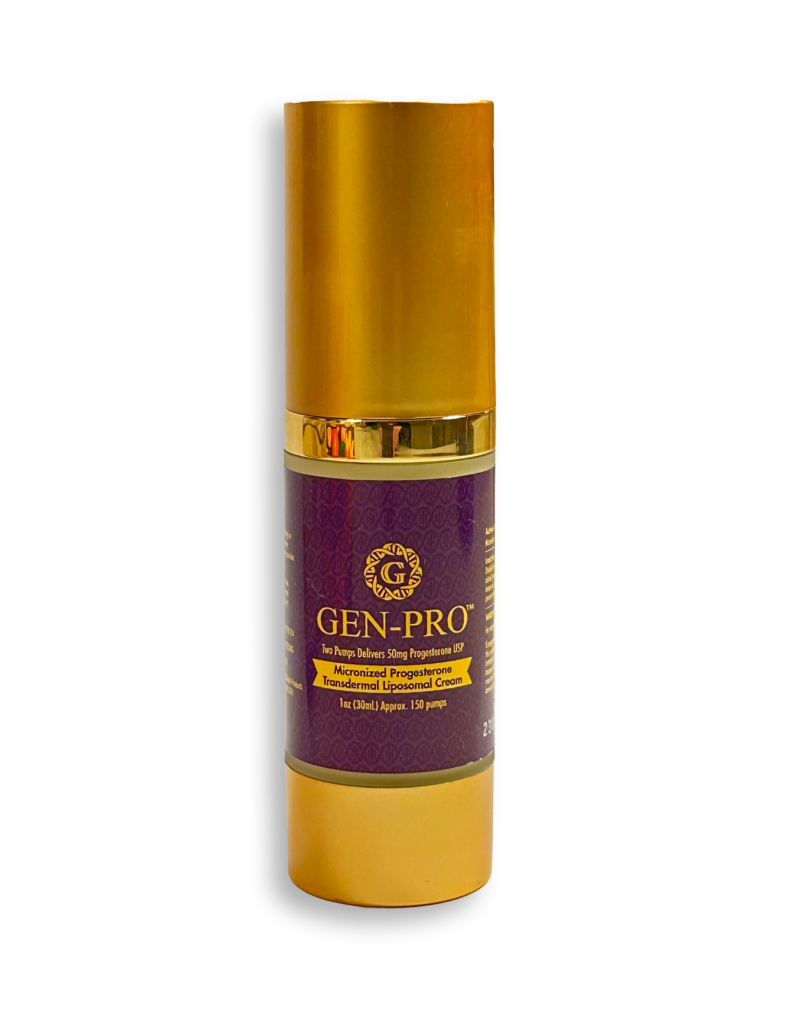
I am so delighted that after three years, we finally have the good stuff, Gen-Pro™.
It's the same exact formula that I used in thousands of my patients very successfully.
What Makes Gen-Pro™ Different
Gen-Pro™ is highly concentrated.
Each .2 milliliter pump delivers 25 milligrams of USP grade micronized bioidentical progesterone from wild yam in a highly absorbable liposomal base.
You will not find a more concentrated progesterone over the counter.
In fact, you will be hard put to find a more concentrated progesterone from compounding pharmacies.
The most popular brands of progesterone cream contain 400 to 500 milligrams per ounce.
Gen-Pro™ is a super concentrated 3,750 milligrams per ounce.
Gen-Pro™ is a true transdermal cream.
The liposomal base with organic essential oils of lemon and rose helps enhance absorption of progesterone.
A transdermal cream doesn't just stay in the skin. It's absorbed through the skin and into the subcutaneous fat to be absorbed into the bloodstream for a systemic effect.
Gen-Pro™ is the good stuff, as my patients refer to it.
Gen-Pro™ is a transdermal progesterone cream I have trusted to balance and heal thousands of my patients with the same USP grade micronized bioidentical progesterone used in prescription progesterone compounds.
How to Use Gen-Pro™
Gen-Pro™ is incredibly cost-effective.
You would spend twice as much on most other over-the-counter products to get the same amount of hormone, and have to use at least quadruple the amount of cream.
For instance, 100 milligrams of Gen-Pro™ is only 0.8 mils of transdermal cream versus one and a quarter teaspoon or six mils of the leading brand.
How Do You Apply Gen-Pro™?
Gen-Pro™ is best applied on the inner thighs.
Your inner thigh has a vascular-rich subcutaneous fat for the best absorption and systemic delivery.
In most cases, Gen-Pro's™ applied twice a day to get good systemic absorption with a 24-hour coverage.
Now, if you're trying to regulate your menstrual periods or if you have PCOS, irregular periods, or are perimenopausal, use four pumps or 100 milligrams of progesterone twice a day starting at the time of ovulation for two weeks.
If you're menopausal, you're going to use one to two pumps twice a day all through the month, taking a three-day break every month.
Now, why would you do that?
Because it takes 72 hours to clear your receptor sites.
You've got about nine months to take progesterone constantly before your hypothalamus says, "It's time to deliver this baby."
Only in pregnancy would you be making progesterone daily for 40 weeks.
So take 72-hour breaks from progesterone each month, and you'll get way more effectiveness as your cell receptors won't become resistant.
Progesterone and Estrogen Balance
Now, for women using estrogen replacement therapy, the rule of thumb is for every one milligram of estradiol, you need about 100 milligrams of progesterone a day.
When you start using progesterone with estrogen in menopause, it's not unusual to have vaginal bleeding. Not really periods, but breakthrough bleeds that usually settle down after a few months.
So, if your balance of progesterone and estrogen is right for you, it'll settle down.
Once you get your symptoms under control, you will need to start tapering your dose so that you're not having menstrual bleeds.
For perimenopause, you can use as much as you need during the two-week luteal phase.
Some of my premenopausal patients need a little extra progesterone in the first half of their cycle, maybe once a day before bed, to help them sleep better or to calm down.
And for men using testosterone replacement therapy, it's recommended to use about 5 to 10 milligrams of progesterone for every 80 to 160 milligrams of testosterone.
Since the Gen-Pro™ pump delivers 25 milligrams, use it once two to three times weekly, according to how much testosterone replacement you're using.
Progesterone is a natural aromatase inhibitor, helping to prevent your testosterone from converting into estrogen.
Quality Ingredients and Manufacturing
Gen-Pro™ uses only USP-grade micronized progesterone sourced from wild yam.
The transdermal liposomal base includes the highest quality ingredients, including organic lemon oil and rose oil.
Gen-Pro™ is made in the U.S. and is non-GMO, paraben-free, soy-free, petroleum-free, and is never tested on animals.
Gen-Pro™ is manufactured in an FDA-approved lab.
The chemical-sounding ingredients are really what make up the liposomal base, and you'll see similar-sounding ingredients in other progesterone creams, but it really matters how those ingredients are mixed together.
My compounding pharmacist perfected it, and the formula has outperformed all others my patients have tried.
Final Thoughts
Gen-Pro™ is the only transdermal cream I trust.
I formulated this amazing, highly absorbable progesterone in a liposomal transdermal base with my trusted pharmacist for my beloved patients.
And now Gen-Pro™ is available to you!

0 Comments