
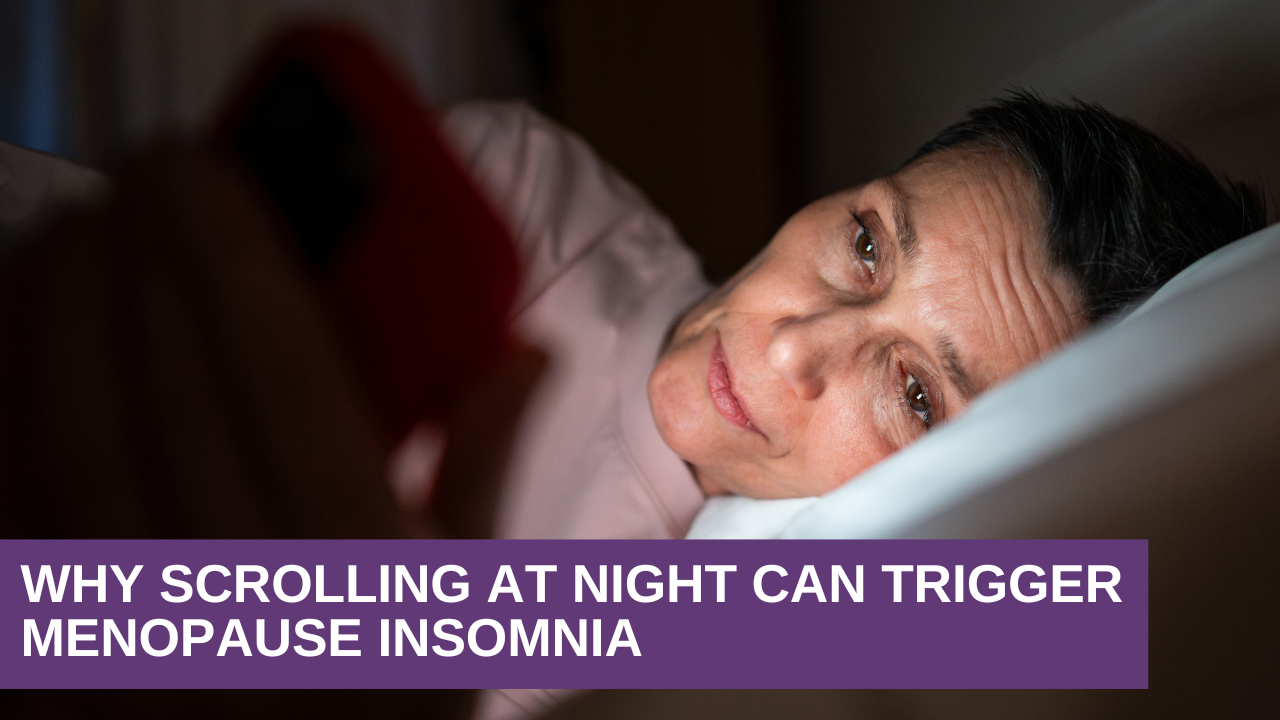
If you’re in perimenopause or menopause and you keep waking up at 2:00 or 3:00 a.m., or you feel exhausted all day but wide awake at night, your phone may be part of the problem. And it is not just because scrolling is distracting. Scrolling at night can actually trigger menopause insomnia by confusing your hypothalamus, suppressing melatonin, raising cortisol, and keeping your nervous system in alert mode when your body should be moving into deep repair.
So today, I’m going to show you why scrolling at night can make menopause insomnia worse, what it does to your hormones, and what you can do instead to finally help your body sleep again.
What is Supposed to Happen at Night?
After dusk, your body is designed to slow down.
Your hypothalamus reads light and darkness from your environment. When it gets the signal that the sun has gone down, it begins preparing your body for sleep.
- Your body temperature should start to lower
- Your cortisol should come down
- Your melatonin should rise
- Your digestion should slow
- Your nervous system should shift out of fight-or-flight and into repair
That rhythm is how your body knows it is safe to sleep.
But When You are Scrolling at Night, Your Hypothalamus Gets a Very Different Message
The light from your phone, especially blue light, tells your brain that it is still daytime.
So instead of making more melatonin, your body may suppress it.
Instead of calming down, your brain stays alert.
Instead of dropping into deep sleep, your nervous system stays activated.
And if you are already in perimenopause or menopause, this becomes even more of a problem.
Why?
Estrogen and Progesterone Help Regulate Sleep
Progesterone has a calming effect on your brain. It supports GABA, which is one of your calming neurotransmitters.
When progesterone starts to decline in perimenopause, you may have a harder time settling down at night.
- You may feel more anxious
- Your thoughts may race
- You may feel tired, but you cannot fully relax
Estrogen also helps regulate serotonin, body temperature, and melatonin rhythms.
When estrogen drops, your hypothalamus becomes more sensitive.
That means small triggers that never bothered you before, like scrolling in bed, staying up too late, or watching a bright screen, can suddenly create a much bigger reaction.
So if you used to scroll at night and still sleep fine, but now you are in midlife and waking up at 3:00 a.m., that is not random.
Your hormone foundation has changed.
Your hypothalamus is more easily disrupted.
And your phone may be telling your body to stay awake.
Cortisol Is Your Stress Hormone
It is supposed to be higher in the morning to help you wake up and lower at night so melatonin can rise.
But scrolling at night can raise cortisol in several ways:
#1: The light itself keeps your brain alert.
#2: The content can trigger stress.
You may see emails, messages, bad news, arguments, health information, work updates, or social media posts that make you compare your life to someone else’s.
Your body does not always know the difference between real danger and emotional stress.
So your hypothalamus may read that scrolling as a threat.
Then it tells your adrenal glands to release cortisol.
And when cortisol rises at night, melatonin drops.
That is when you may feel wide awake, even though you were exhausted an hour earlier. Or you may fall asleep, but wake up around 2:00 or 3:00 a.m. with your mind racing.
That early morning waking is often a cortisol rhythm problem.
Your body should still be in deep sleep, but instead, your stress response starts turning back on too soon.
Menopause Insomnia is So Common
During menopause, your hypothalamus is already working harder to regulate temperature, mood, metabolism, blood sugar, and sleep because your sex hormones are declining.
That is why menopause insomnia is so common.
And it is also why nighttime scrolling can hit harder.
→ Your body may already be struggling to make enough melatonin.
→ You may already be more sensitive to heat.
→ You may already be more prone to night sweats.
→ You may already be dealing with blood sugar swings.
→ You may already be waking up to urinate.
Then scrolling adds another signal of stress and light at the exact time your hypothalamus needs darkness and calm.
What Does That Look Like in Real Life?
You get into bed tired.
You tell yourself you are just going to scroll for five minutes.
Then twenty or thirty minutes go by.
Your brain sees light.
Your emotions react to what you are reading.
Your dopamine system gets stimulated by the constant novelty.
Your cortisol may rise.
Your melatonin gets suppressed.
Your body temperature may not drop the way it should.
Then you put your phone down and wonder why you cannot sleep.
Or you do fall asleep, but your sleep is lighter.
Then at 3:00 a.m., you wake up.
You check the time.
You grab your phone again.
And now your hypothalamus gets another blast of light and stimulation in the middle of the night.
That can train your brain to stay awake at the same time again and again.
So what can you do?
#1: Create a Screen Sunset
Just like the sun sets outside, your screens need to set too.
Try to be off your phone at least one hour before bed. If that feels impossible, start with thirty minutes.
The goal is not perfection.
The goal is to give your hypothalamus a clear signal that the day is ending.
#2: Dim Your Lights After Dusk
Bright overhead lights can also confuse your hypothalamus.
After dinner, lower the lights. Use dimmer lamps. Avoid bright bathroom lights right before bed.
Your brain needs darkness to make melatonin.
#3: Replace Scrolling with a Calming Ritual
Most people do not scroll at night because they need information.
They scroll because they are tired, overwhelmed, lonely, anxious, or trying to decompress.
So give your nervous system a better way to decompress.
- Read a calming book
- Take a warm bath
- Stretch
- Pray
- Journal
- Listen to calming music
- Do slow breathing
- Put your hand over your heart and remind your body, “I’m safe. The day is done.”
Your hypothalamus responds to safety.
#4: Keep Your Phone Out of Bed
Your bed should be a sleep cue, not a scrolling cue.
If your brain associates bed with light, stimulation, stress, and dopamine, it becomes harder to sleep deeply.
Charge your phone across the room. Use a real alarm clock if you need one. And if you wake up in the middle of the night, do not check your phone.
Even checking the time can make your brain more alert.
#5: Support Your Blood Sugar Before Bed
If you wake around 3:00 a.m., it may not only be light and cortisol.
It may also be blood sugar.
When blood sugar drops too low overnight, your hypothalamus signals your adrenal glands to release cortisol to bring blood sugar back up.
That cortisol spike can wake you.
- Avoid sugar, alcohol, and starchy carbs after dark
- Eat dinner earlier
- Make sure dinner has protein, healthy fat, and low-glycemic vegetables
- And try to finish eating at least three hours before bed
#6: Support Your Hypothalamus
This is the part most people miss.
Menopause insomnia is not just a sleep problem.
It is a hypothalamus rhythm problem.
Your hypothalamus controls your sleep-wake cycle, body temperature, cortisol rhythm, hunger, blood sugar, mood, and hormone communication.
When your hypothalamus is stressed, your whole sleep system becomes unstable.
That is why one night of scrolling can create a bigger reaction in menopause than it did when you were younger.
Your body is asking for rhythm.
- Light in the morning
- Darkness at night
- Stable blood sugar
- Calm evenings
- Earlier dinner
- Less stimulation
- More safety
Struggling with Menopause Insomnia?
So if you are struggling with menopause insomnia, start by protecting the two hours before bed.
That is when you teach your hypothalamus whether it is safe to sleep or whether it needs to stay on alert.
Scrolling at night may feel relaxing in the moment, but to your hormones, it may be sending the wrong message.
It says daytime.
It says stimulation.
It says danger.
It says stay awake.
Darkness says repair.
Calm says safety.
Rhythm says sleep.
If you are dealing with menopause insomnia, 3:00 a.m. waking, night sweats, anxiety, belly fat, or feeling wired but tired, I created my free Hormone Reboot Training to help you understand how to support your hypothalamus and bring your hormones back into balance naturally.
Do you scroll at night or check your phone when you wake up at 3:00 a.m.?

Frequently Asked Questions
Why does scrolling at night make menopause insomnia worse?
Scrolling at night can worsen menopause insomnia because the light — especially blue light — signals your hypothalamus that it's still daytime, which suppresses melatonin. The stimulating content can also raise cortisol, your stress hormone, right when it should be falling. In perimenopause and menopause, declining estrogen makes the hypothalamus more sensitive, so screen exposure that didn't bother you before can now keep your nervous system in alert mode when your body should be moving into deep sleep.
Why do I keep waking up at 3 a.m. during menopause?
Waking around 2:00 to 3:00 a.m. in menopause is often a cortisol rhythm problem. Your body should still be in deep sleep, but your stress response turns back on too early, pulling you awake, often with a racing mind. This can be triggered by light exposure, stress, or a blood sugar dip overnight — when blood sugar drops too low, the hypothalamus signals a cortisol release that wakes you. Declining hormones make this pattern more common in midlife.
How do estrogen and progesterone affect sleep?
Both hormones support sleep. Progesterone has a calming effect on the brain because it supports GABA, a calming neurotransmitter, so when progesterone declines in perimenopause, it can be harder to settle down and relax at night. Estrogen helps regulate serotonin, body temperature, and melatonin rhythms, so as it drops, the hypothalamus becomes more sensitive and sleep becomes more easily disrupted. This is why sleep problems are so common during the menopause transition.
Does blue light really affect melatonin?
Yes. Light exposure, particularly the blue light emitted by phones and screens, signals the hypothalamus that it's daytime, which suppresses the release of melatonin — the hormone that helps you fall and stay asleep. When melatonin is suppressed in the evening, your body doesn't get the clear "time to sleep" signal it needs. Reducing screen exposure in the hours before bed helps melatonin rise naturally so you can wind down.

0 Comments