
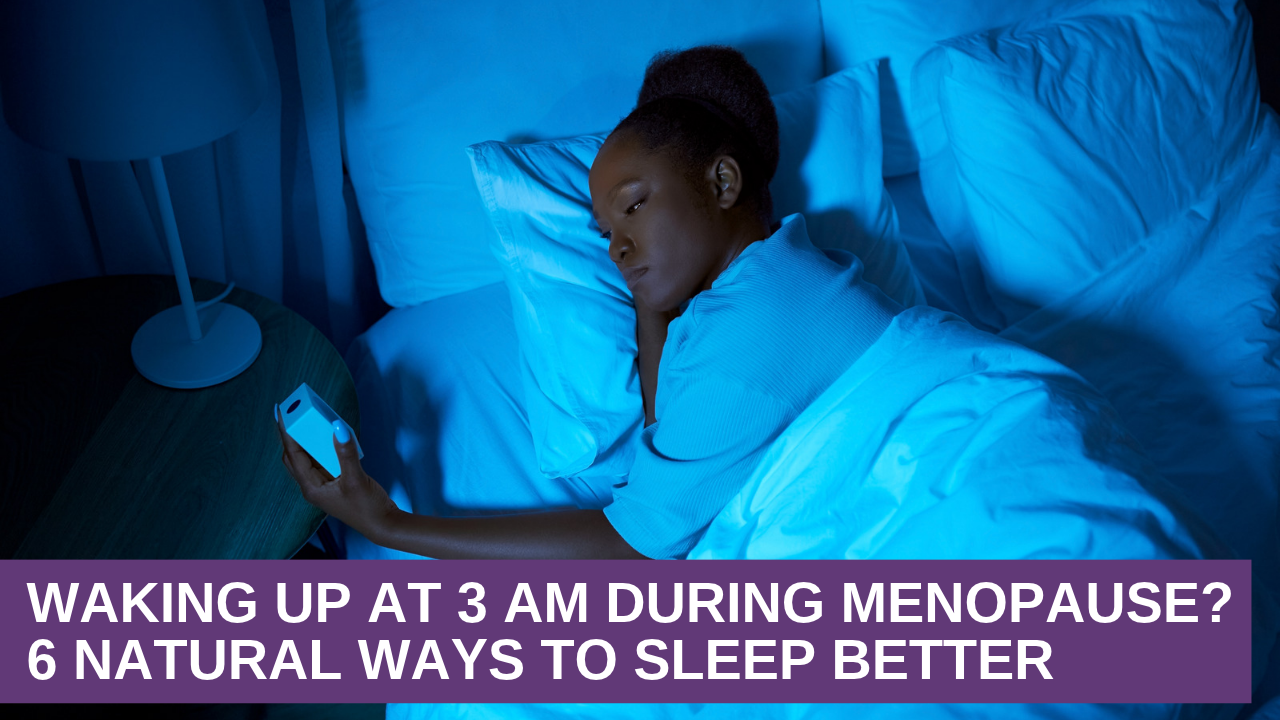
If you keep waking up at 3 AM during menopause and can’t get back to sleep, this is for you. I’m going to show you six natural ways to sleep better and explain why this keeps happening — because it’s not just “hormones changing.” There’s a specific mechanism, and once you understand it, the fix makes a lot more sense.
Your hypothalamus has a region called the suprachiasmatic nucleus — think of it as your internal clock. It reads light and darkness and times the release of melatonin, the hormone that tells your body it’s time to sleep.
Waking Up At 3 Am Throughout Menopause
During menopause, declining estrogen and progesterone don’t just affect your ovaries. They disrupt the signaling going into that clock. Melatonin production drops. Vasopressin — another hormone the hypothalamus regulates — also declines, and vasopressin is what tells your kidneys to concentrate urine overnight. When it drops, you make more urine at night, which is a big reason so many women suddenly need to get up to use the bathroom in perimenopause and menopause.
And here’s the part most women never hear: when your sleep architecture breaks down like this, your body reads it as a stressor. That triggers a cortisol surge in the middle of the night — which is exactly why you wake up at 3 AM not just awake, but wired, sometimes with your heart racing. That’s not “just poor sleep.” Repeated nighttime cortisol surges are associated with increased cardiovascular inflammation over time. This is bigger than feeling tired the next day.
Here’s What You Can Do
#1: Keep a Regular Bedtime
Your body likes a predictable sleep schedule. Going to bed at 10 one night and midnight the next keeps changing the signal you’re giving your internal clock. Try winding down around the same time each evening.
#2: Put the Screens Away at Night
Light exposure interferes with melatonin production right when your hypothalamus is already struggling to get the pineal gland to make enough of it.
If you wake at 3 AM, don’t reach for your phone.
#3: Keep Your Bedroom Dark and Cool
Hot flashes and night sweats compound this problem. Keep the room cool and use bedding that won’t make you overheat.
#4: Get Daylight During the Day
Morning light exposure helps reset that suprachiasmatic clock, which gives your body a clearer signal of when it’s supposed to wind down at night.
#5: Eat Dinner Earlier
Give your body time to digest before it’s trying to shift into nighttime rhythm.
#6: If You Wake Up, Keep it Nighttime
No bright lights, no scrolling. Try slowly tightening and relaxing your muscles from your feet up while breathing slowly — it gives your mind something physical to focus on instead of the cortisol-driven racing thoughts.
Genesis Gold® - To Help Support Hypothalamic Function Throughout Menopause
These habits help. But they’re working with a hypothalamus that’s already under more strain during menopause. That’s part of why I formulated Genesis Gold® — to help support hypothalamic function throughout menopause, so it can regulate melatonin, vasopressin, and cortisol more the way it did before this transition started. Supporting that terrain is often what makes these sleep habits actually work instead of just helping a little.
If you want to understand how your hypothalamus affects all of your hormones — sleep, cortisol, and everything else — and what you can do about it, that’s exactly what I teach in my Free Hormone Reboot Training.
Genesis Gold® is formulated to support your hypothalamus to help control symptoms from perimenopause through postmenopause, to help reset your circadian clock, deepen your sleep, and get more energy.



0 Comments