
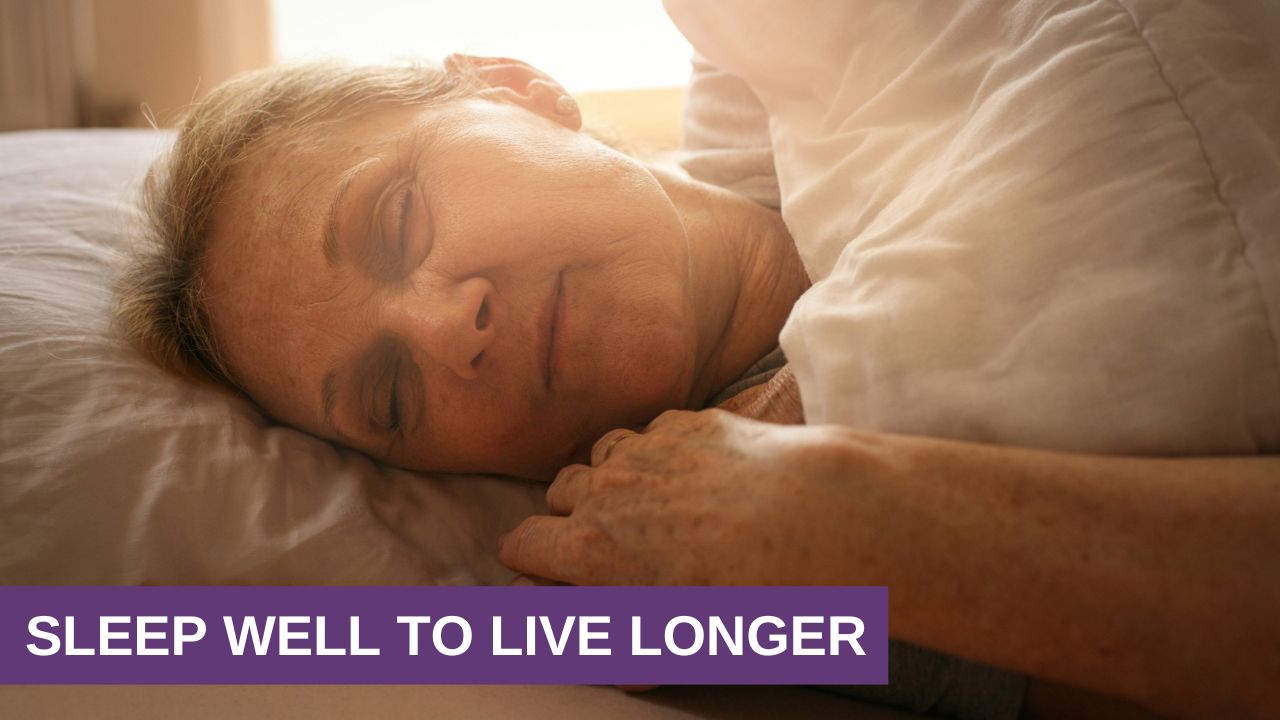
How Deep Sleep Slows Aging: A Hormone Specialist's Guide to Slow-Wave Sleep and Longevity
Deep sleep slows down biological aging since it is the only time when various repair systems operate at full capacity – including the glymphatic clearance of brain waste, the release of growth hormone, DNA repair, and immune signaling. If deep sleep is short or fragmented then these processes come to a halt. Research has found that sleep lying outside the optimal range is linked to faster aging in almost every organ.
The short version:
- Deep sleep (slow-wave sleep) makes up roughly 10–20% of a normal night — about 40 to 110 minutes
- It clusters in the first third of the night, which is why a consistent bedtime protects it better than sleeping in
- Your hypothalamus sets the timing for every repair process that follows
- Four habits protect it: consistent bedtime, a 60-minute wind-down, a cool room (64–68°F), and no food within three hours of bed
- Deep sleep declines naturally with age — which is exactly why protecting what you have matters more each decade
Does deep sleep really slow down the process of aging?
Yes, deep sleep — which is also called slow-wave sleep — is the most important stage of the sleep cycle when it comes to slowing down biological aging and preventing age-related diseases.
A study conducted at Columbia University Irving Medical Center, which used organ-specific aging clocks on data from about half a million participants in the UK Biobank, discovered that both sleeping for too little and sleeping for too much was linked to faster aging in the brain and in almost all of the other organs. The connection is not linear; it's based on a range. If you go beyond this range in either direction, your organs will age more quickly than your age would indicate.
There's a longevity signal in the other direction, too. When researchers studied adults aged 85 to 105, they found that the oldest old maintained strictly regular sleep-wake schedules, and their slow-wave sleep percentage and delta power were comparable to young adults — even though other aspects of their sleep had declined.
Consistency and preserved deep sleep. That's the pattern in people who make it to 100.
How much deep sleep do you need?
Most healthy adults spend 10–20% of the night in deep sleep — roughly 40 to 110 minutes across seven to nine hours of total sleep. (You'll also see 13–23% cited widely; both ranges come from polysomnography research.)
Three things are worth knowing:
- It front-loads. Slow-wave sleep dominates your first two sleep cycles and tapers across the night. Going to bed late costs you deep sleep specifically — not just sleep generally.
- It declines with age. Adults in their twenties get the most. By the sixties and seventies, under 10% is common and not a disorder.
- You can't force it directly. You can only create the conditions. That's what the next four habits do.
Deep sleep vs. REM sleep: what's the difference?
Both matter. They do different jobs, at different times of night, under different hypothalamic control.
| When | First third of the night | Final third, before waking |
| Brain waves | Slow delta waves | Fast, near-waking patterns |
| Primary job | Physical repair and waste clearance | Emotional and memory processing |
| Key processes | Glymphatic flush, growth hormone, DNA repair, immune signaling | Hippocampus-to-cortex memory transfer, emotional reprocessing |
| Memory type | Facts and information | Social-emotional memories |
| Hypothalamic role | Sets timing via the SCN; GHRH pulses drive GH release | MCH neurons fire almost exclusively here |
| Protected by | An early, consistent bedtime | A full night — cutting sleep short cuts REM first |
The practical upshot: going to bed late costs you deep sleep. Waking up early costs you REM. You need both, which is why the window matters at both ends.
How to get more deep sleep: 4 habits
1. Fix your bedtime — same time every night, ±30 minutes maximum
This is the foundation. Your hypothalamic circadian clock doesn't understand "catching up on sleep." It only understands consistency.
Stick with it for two weeks, and you'll notice your sleep onset time dropping — because your brain has learned: this is when we shut down.
2. Shut down your nervous system 60 minutes before bed
For 60 minutes before bed: no screens, no large meals, no intense exercise, no work messages.
- Blue light activates the hypothalamus, which in turn suppresses melatonin
- A large meal raises your core body temperature at exactly the moment it needs to fall
- Work messages activate stress circuits
These 60 minutes are your transition from high alert mode to repair mode.
3. Keep your bedroom cool
What is the best bedroom temperature for deep sleep? 64–68°F (18–20°C).
A drop in core body temperature is the physiological trigger for deep sleep onset — the room temperature isn't a comfort preference, it's a signal.
If you feel cold, wear socks. Warm feet dilate the blood vessels in your extremities, which releases heat from your core and accelerates the temperature drop. Counterintuitive, but it works.
4. Stop eating three hours before bed
Late eating works against deep sleep in three ways:
- Core temperature. Digesting a meal raises it just when it needs to drop — the very signal that triggers slow-wave sleep.
- Reflux. Lying down on a full stomach fragments sleep even when you never fully wake.
- Clock mismatch. Your liver, gut, and pancreas run their own peripheral clocks. Feeding them at 10 PM tells them it's still daytime while your brain is trying to shut down.
That mismatch between your master clock and your organ clocks is one of the most reliable ways to blunt deep sleep and delay the repair work that depends on it.
What your hypothalamus is doing while you sleep, hour by hour
Timed from sleep onset, not by the clock — so this works whether you sleep at 10 PM or 2 AM. Clock times assume a 10 PM bedtime.
Hours 0–1 after sleep onset (about 10–11 PM): your sleep onset window
The hypothalamic suprachiasmatic nucleus (SCN) acts as your master biological clock. As darkness falls, the SCN signals the pineal gland to release melatonin, which in turn triggers hypothalamic release of GABA that deactivates arousal centers and initiates sleep.
Miss this window, and sleep onset becomes significantly harder.
Hours 1–3 (about 11 PM–1 AM): deep sleep peak
Your hypothalamus sets this window. What happens inside it is remarkable.
Your brain gets flushed. During deep sleep, norepinephrine released from the locus coeruleus pulses in slow rhythmic waves, causing cerebral blood vessels to expand and contract in a rhythm called vasomotion. That rhythm acts as a pump, driving cerebrospinal fluid through brain tissue and clearing out beta-amyloid and tau. This is your glymphatic system, and it runs almost exclusively during slow-wave sleep. Miss the deep sleep window, and you miss the flush.
Your body rebuilds. Your hypothalamus pulses growth hormone-releasing hormone (GHRH), signaling your pituitary to release growth hormone for cellular repair.
Your memories consolidate. Deep sleep moves information from short-term to long-term storage.
These are the golden hours of physical rejuvenation.
Hours 3–5 (about 1–3 AM): DNA repair peak
Cellular repair mechanisms engage at full capacity. Liver detoxification reaches its maximum.
Hypothalamic dopamine withdraws, allowing your pituitary to release a surge of prolactin that supports immune signaling and helps repair tissue damaged during the day.
Hours 5–7 (about 3–5 AM): REM sleep dominance
Information learned during the day transfers from the hippocampus to the cortex for long-term storage. Emotional memories are reprocessed.
REM assists memory differently than deep sleep — focusing on social-emotional memories and even salvaging forgotten ones. The hypothalamic melanin-concentrating hormone neurons fire almost exclusively during REM sleep, helping suppress wakefulness centers and regulate REM dynamics.
Hours 7–9 (about 5–7 AM): brain and body awaken
The SCN receives direct light cues from your eyes to re-anchor your circadian rhythm. Dawn awakens the hypothalamus, which shuts down pineal melatonin production. Your hypothalamus produces dopamine to shut down prolactin and promote alertness.
Then your circadian clock initiates the cortisol awakening response: the SCN signals the hypothalamic paraventricular nucleus to release CRH → CRH triggers pituitary ACTH → ACTH prompts your adrenals to produce cortisol — releasing stored sugar to fuel your brain and body until you break your fast.
The best time to wake up without having to use an alarm is during this period.
How supporting your hypothalamus nutritionally improves sleep and longevity
What is common to all the stages mentioned above is that your hypothalamus is in control of them.
While most of your brain is protected by a barrier, a portion of your hypothalamus is situated behind a specialized and more permeable one. The median eminence has fenestrated blood vessels which directly draw on your bloodstream — this means that what you feed to your hypothalamus is more important than almost anywhere else in the nervous system.
For your hypothalamus to function at its best, it is necessary to have certain amino acid combinations, essential nutrients from a wide range of whole sprouted foods and sea vegetation, and plant-based support for detoxification. Genesis Gold supplies the nutrition required for your hypothalamus to function optimally.
Over a period of more than twenty years since its use, patients and customers have said that they experience deeper sleep, remember their dreams better, and have improved memory and concentration.
In the way I deal with patients I have noticed that those who continuously use Genesis Gold usually have biological ages that are younger than their chronological ages.
If you want to find out more about supporting your hypothalamus, why not enroll in our hormone reboot training?

These statements have not been evaluated by the Food and Drug Administration. This product is not intended to diagnose, treat, cure, or prevent any disease. Individual results vary.
Sources
Sleep and the glymphatic system / slow-wave sleep and brain clearance

0 Comments