
Have your periods suddenly gotten heavier, your breasts feel sore for days, and you’re so bloated that your rings or clothes feel tighter even though you haven’t gained much weight? Maybe your PMS is hitting harder too, with more irritability, headaches, or trouble sleeping around your cycle.
If several of these changes are happening together, this is for you. I’m going to show you seven warning signs that estrogen may be having too strong an effect in your body, why it happens, and what you can do about it.
First, when I say high estrogen, I don’t always mean your estrogen level is extremely high. Especially during perimenopause, estrogen can still fluctuate quite a bit while progesterone starts declining because you’re not ovulating as consistently. So sometimes estrogen is simply having a stronger effect relative to progesterone.
Here Are 7 Signs of Estrogen Dominance to Watch For
#1: Heavier Periods
Estrogen stimulates the uterine lining to grow; progesterone regulates that lining after ovulation. Less progesterone means heavier bleeding.
#2: Irregular Periods
This happens when you’re not ovulating consistently, since progesterone is mainly produced after ovulation.
#3: Sore or Swollen Breasts
Estrogen promotes breast tissue growth
#4: Bloating and Water Retention
Estrogen increases intracellular fluid, which affects how much fluid you retain.
#5: Stronger PMS
Progesterone has calming effects in the nervous system, so declining progesterone often makes PMS harder.
#6: Trouble Sleeping
Often reflects the shifting relationship between estrogen and progesterone rather than estrogen alone. Less progesterone means less calming GABA production to help you fall and stay asleep.
#7: Fibroids May Become More Noticeable
Fibroids respond to estrogen’s growth stimulation, so symptoms can intensify while estrogen is still present but progesterone is declining.
Why Does This Happen?
In perimenopause, ovulation becomes less consistent. Without ovulation, you don’t get the normal rise in progesterone afterward, while estrogen is still rising and falling from month to month. That imbalance is what creates these symptoms — not necessarily “too much” estrogen, just not enough progesterone to balance it.
How Do You Fix It?
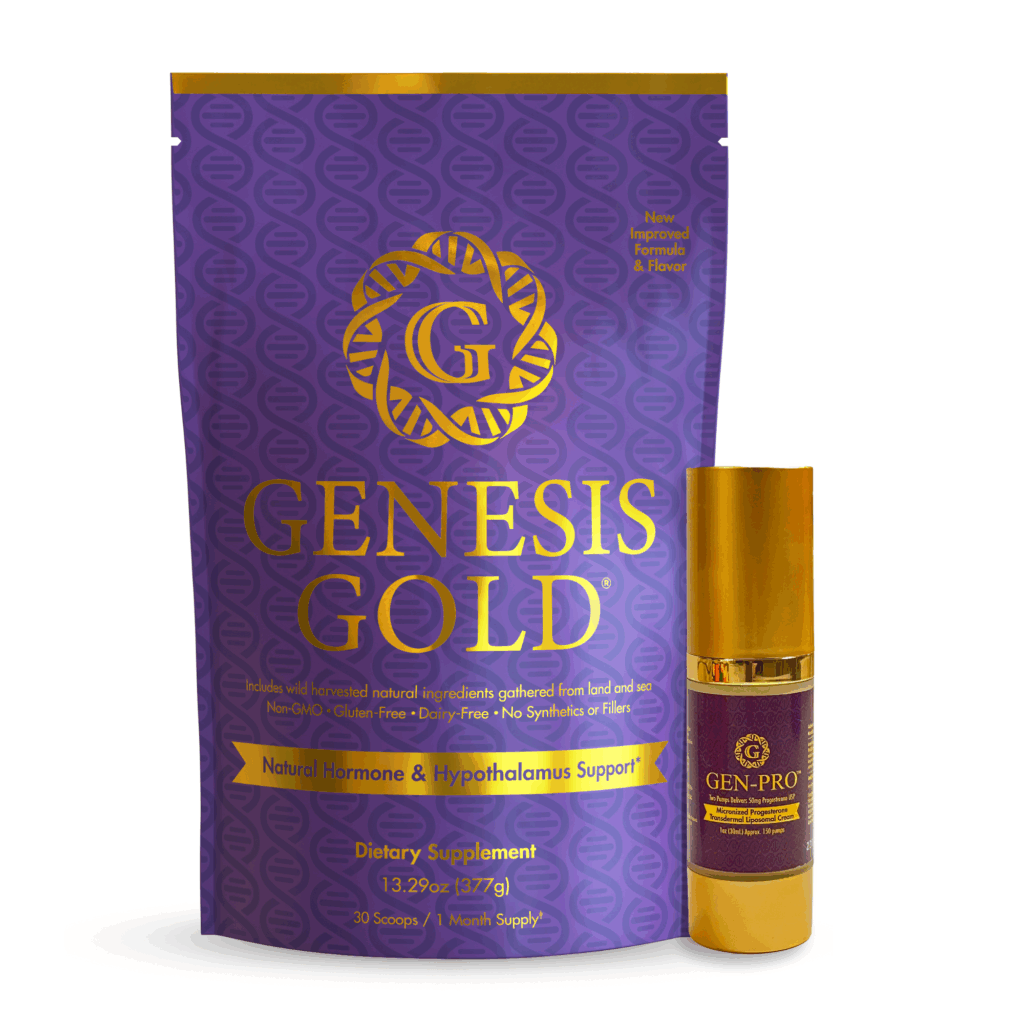
Supplementing with micronized progesterone can help regulate your cycle and restore that balance. That’s exactly why I created Gen-Pro™ — a prescription-grade transdermal, highly absorbable micronized progesterone that helps balance out perimenopausal estrogen levels, regulate your cycles, and reduce estrogen dominance directly.
And there’s a deeper layer here too.
Your hypothalamus is part of the communication system regulating ovarian hormone signals, so as ovulation becomes less consistent, the whole pattern of estrogen and progesterone becomes less predictable.
Supporting your hypothalamus with Genesis Gold® helps ease perimenopausal symptoms more broadly — decreasing PMS, reducing estrogen dominance, and helping regulate your menstrual cycles from the source, alongside what Gen-Pro™ is directly restoring.
One more thing: not every heavy period or symptom here should automatically be blamed on perimenopause. Fibroids, adenomyosis, ovarian cysts, and endometriosis can cause similar symptoms, so if bleeding becomes extremely heavy or you develop significant pelvic pain, get evaluated.
If you want to understand how estrogen, progesterone, and your hypothalamus fit together — and how Genesis Gold® and Gen-Pro™ can help — that’s what I teach in my Free Hormone Reboot Training.

0 Comments