
If you're struggling with that stubborn belly fat since menopause, you're not alone. It's not just what you're eating or how active you are. Your hormones are calling the shots. Today, I am going to show you how to pay attention so that you can start losing that extra belly fat.
Once you reach menopause, it seems like weight gain happens out of nowhere, doesn't it? Once you stop having periods, sometimes even before your waistline starts expanding, and now you've got belly fat that you didn't have before. It is natural, but thank goodness it's fixable.
What Causes Menopausal Belly Fat?
#1: The Decline in Estrogen
As your estrogen levels decline in menopause, your metabolism starts to decline. You become less insulin sensitive, and your weight set point starts to raise. That decrease in insulin sensitivity causes insulin resistance, and it's harder to burn that fat. You're more likely to store fat in your belly. That adipose tissue around your waist and also in your viscera is not healthy fat.
Estrogen helps control your appetite and increases your body's ability to burn fat. Without adequate estrogen production, your body is better at storing fat.
#2: The Decline of Progesterone
Progesterone enhances estrogen receptors. Less estrogen means lower metabolism. Declining progesterone levels in perimenopause increase adrenal stress as the adrenals use ovarian progesterone to make cortisol. Without adequate progesterone, your body's much less calm, and you're much more likely to emotionally eat and lay down body fat.
Stress increases cortisol levels. Chronically high cortisol promotes insulin resistance.
#3: The Decline of Testosterone
In women, testosterone helps to increase muscle and bone mass. As testosterone falls, postmenopausally, women lose lean body mass, resulting in much slower metabolism.
It really isn't about the calories you're eating. It's about your metabolism, particularly in your neuroendocrine chemistry. That's why diet and exercise alone won't help you lose belly fat. Menopausal women try to cut calories or try intermittent fasting, or go on a very restrictive diet, or over exercise.
When you have a big change in your diet or you exercise too much, it actually increases your cortisol, which then increases the likelihood that you're going to store more body fat, especially around your belly.
The post-menopausal slowdown of metabolism actually is initiated by the decline in sex hormones. It's followed by a decline in thyroid hormone production. And when you throw in poor sleep because your estrogen is bottomed out, and you wake up with hot flashes and night sweats, well, you don't make enough melatonin to make enough growth hormone to actually stimulate your lean body mass, muscle, and bone. Your metabolism is even slower.
Who Orchestrates All These? Your Hypothalamus.
Your hypothalamus controls your adrenal glands, your thyroid gland, your sex hormones, and communication between your fat cells, your gut microbiome, and your cellular metabolism.
The hypothalamus knows exactly how much fat you're storing. It also knows when you're hormonally challenged. When you're no longer making the hormones your body used to make, it's going to slow your metabolism down, so you don't need so many hormones to survive. That means you're going to store more fat.
Reset Your Hormones and Metabolism Naturally
Now, let's talk about how you can reset your hormones and metabolism naturally.
#1: Eat a Plant-Based Mediterranean Diet
Make sure you're getting at least a half a gram of protein per pound of lean body mass and focus on healthy fats.
Monounsaturated fats like olive oil and avocado oil. Nuts and seeds will help stabilize your blood sugar. Avoid any excessive amount of starches and sugar. Limit highly processed foods and alcohol, starch and sugar will spike your insulin levels and increase the likelihood of insulin resistance over time.
#2: Be Sure You're Getting Enough Sleep
At least seven to nine hours in the dark will help to reduce cortisol and increase melatonin, which will increase growth hormone levels. Which means you're going to have much more metabolically active lean body mass.
#3: Be Sure to Move Your Body Daily, Not Just Exercise
Yes, you definitely want to do aerobic exercise and weight resistance exercise, but you should be moving throughout the day. You can't be sitting for eight hours a day and expect to lose body fat with only 30 minutes of exercise a day. It won't be enough. You've got to be moving around.
Get up and walk, use the stairs, park farther away. Move your body.
#4: Learn to Manage Your Stress
The lower your cortisol levels are, the more likely your hypothalamus isn't going into fight or flight mode, and lowering your metabolism. Practice stress-reducing techniques like my calm meditation, which you can access in my free Hormone Reboot Training.
#5: Support Your Hypothalamus Neutraceutically
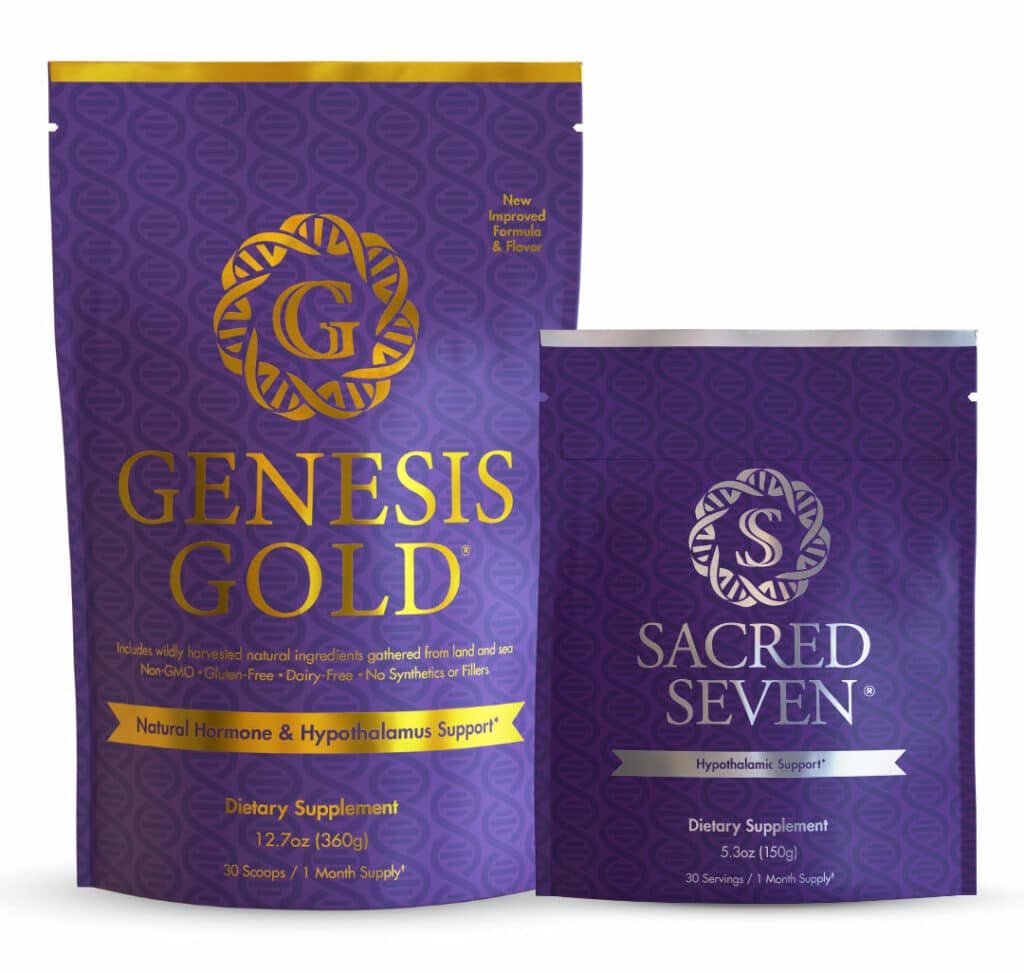
Now this is my secret sauce in maintaining lower body fat and menopause. Not having belly fat is supporting my hypothalamus nutraceutically. Supporting my hypothalamus with Genesis Gold® has allowed my metabolism to stay high. I can pretty much eat the same amount of calories as I ate when I was younger.
With all the energy I have, I stay very active. When your hypothalamus is getting all the phytonutrients it needs from Genesis Gold®, it harmoniously orchestrates all your hormones, your neurotransmitters, your immune system, your gut microbiome, and communicates with your fat cells. Everything stays in balance, and you're able to be more metabolically active.
You have more lean body mass from the activities that you're doing and a higher metabolism. You're less likely to store body fat in your belly. Supporting your hypothalamus balances out your hormonal rhythms. You don't have cortisol spikes in the middle of the night; you make enough melatonin and enough growth hormone at night.
You have good cortisol levels during the day to handle normal daily stressors. Your thyroid function is better, your receptor site activity is better. So thyroid hormone and sex hormones can get into those cells and control your metabolism at much more youthful levels.
Reducing Inflammation Helps to Decrease Body Fat
By supporting your hypothalamus, you're reducing inflammation, and that helps to decrease body fat. Your body fat is the place where a lot of toxins and inflammatory metabolites are stored. If you've been overweight for a long time, you might need to add Sacred Seven® amino acids to your Genesis Gold® for extra hypothalamic support to really give your body what it needs and get your hormones in the best balance possible to raise your metabolism.
You don't have to fight your body when you understand what's happening.
When you support your hypothalamus, you can finally feel like yourself again.
Please subscribe to get more videos like this. Comment on your experience on supporting your hypothalamus and losing that belly fat. You can learn a lot more about how you can support your hypothalamus in our free Hormone Reboot Training and get access to all my nutritional plans, exercises, and meditations that I recommend for my patients.

Why do women gain belly fat after menopause?
Women gain belly fat after menopause primarily because of the dramatic decline in estrogen, progesterone, and testosterone that occurs when the ovaries stop functioning. Estrogen plays a direct role in regulating metabolism, controlling appetite, and directing where the body stores fat. When estrogen drops, the body becomes less insulin sensitive, making it far easier to store fat — particularly in the abdominal area. At the same time, falling progesterone levels increase adrenal stress, which drives up cortisol. Chronically elevated cortisol signals the body to store visceral fat around the midsection as a survival mechanism. Declining testosterone further slows metabolism by reducing lean muscle mass. All of these hormonal shifts are coordinated by the hypothalamus, which responds to lower hormone levels by intentionally downregulating metabolism — making menopausal belly fat a hormonal problem, not simply a diet or willpower issue.
What hormone is responsible for belly fat after menopause?
Several hormones contribute to belly fat after menopause, but cortisol and insulin resistance are the most direct drivers of abdominal fat storage. As estrogen declines, insulin sensitivity decreases, meaning the body is less efficient at using glucose for energy and more likely to store it as fat. Cortisol — the stress hormone produced by the adrenal glands — rises in part because the adrenals compensate for falling ovarian progesterone. High cortisol specifically promotes visceral fat accumulation around the belly and organs. Low estrogen also reduces the body's fat-burning capacity and shifts fat distribution away from the hips and thighs toward the abdomen. Supporting the hormonal system as a whole — rather than targeting any single hormone in isolation — is key to addressing menopausal belly fat effectively.
Does losing estrogen cause belly fat?
Yes, the loss of estrogen is one of the primary drivers of belly fat in menopause, though the mechanism is indirect. Estrogen helps regulate metabolism, maintain insulin sensitivity, and control where fat is deposited in the body. When estrogen levels fall, the body's metabolic rate slows, fat-burning efficiency drops, and the body preferentially begins storing fat in the abdomen rather than the hips and thighs — a pattern that is both hormonally driven and metabolically significant. Visceral fat, the deep abdominal fat that surrounds the organs, is particularly associated with low estrogen states and carries a higher risk of metabolic disease than subcutaneous fat. This is why women who had relatively flat midsections before menopause often notice rapid abdominal weight gain in the years following their final period, even without significant changes in diet or activity level.
How do you get rid of belly fat after menopause naturally?
Getting rid of belly fat after menopause naturally requires addressing the hormonal root causes rather than relying solely on caloric restriction or exercise. Extreme dieting and over-exercising can actually backfire by raising cortisol, which makes belly fat worse. Instead, the most effective natural approach focuses on eating a plant-based Mediterranean diet rich in healthy fats and adequate protein, prioritizing seven to nine hours of quality sleep nightly to support melatonin and growth hormone production, moving consistently throughout the day rather than relying on a single exercise session, and actively managing stress to keep cortisol low. Supporting the hypothalamus — the master gland that coordinates estrogen, progesterone, thyroid, cortisol, and cellular metabolism — is central to this approach. When the hypothalamus is well-nourished and functioning optimally, it can help restore hormonal balance, increase metabolic rate, and reduce the inflammatory burden that keeps visceral fat locked in place. Genesis Gold® was formulated specifically to provide the phytonutrients the hypothalamus needs to orchestrate this system-wide hormonal harmony.

0 Comments