
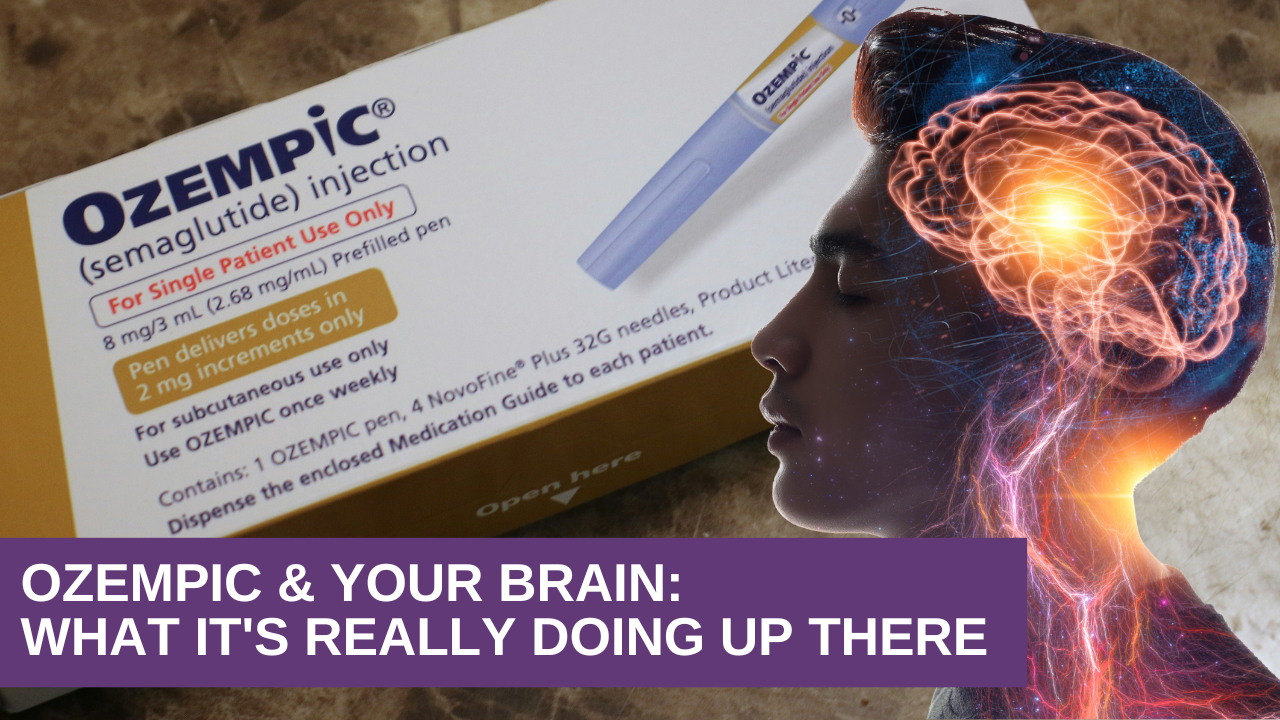
Ozempic doesn't work on your stomach. It works on your brain — on a structure the size of an almond that I've spent thirty years studying. And once you understand what these drugs are actually doing up there, two things finally make sense: why they work so well, and why coming off them can feel so brutal.
If you're on a GLP-1, considering one, or watching someone you love navigate this — this is the explanation you haven't been given. Most of what's written about Ozempic, Wegovy, and Mounjaro focuses on the stomach: slower emptying, less appetite, fewer calories in. That part is accurate. But it's incomplete. And the incomplete version is why so many women — especially in midlife — feel confused about what these drugs are actually doing to their bodies.
Let's fix that.
GLP-1 Medications: What They Are and Where They Actually Work
GLP-1 receptor agonists — the drug class that includes semaglutide (Ozempic, Wegovy) and tirzepatide (Mounjaro, Zepbound) — were originally developed to manage blood sugar in type 2 diabetes. The weight loss effect was noticed later, studied intensively, and eventually became the primary reason most people are now prescribed them.
The name tells you something. GLP-1 stands for glucagon-like peptide-1, a hormone your gut naturally releases after eating. It signals fullness, slows gastric emptying, and nudges insulin production. The drugs mimic this signal — but at much higher potency and for far longer than your body's own version ever would.
Everyone says these drugs "make you feel full." That's true. But where that fullness is generated is the part that actually matters — and it's not in your stomach.
The Real Mechanism: Your Hypothalamus Is the Target
GLP-1 receptor agonists cross into the brain and act directly on the hypothalamus — your body's master control center for appetite, satiety, metabolism, temperature, sleep, and hormone regulation. They turn down the hunger neurons (AgRP neurons) and amplify the fullness neurons (POMC neurons). The result is a powerful, persistent reduction in appetite that goes well beyond what any behavioral or dietary intervention can produce.
Your hypothalamus is the maestro of your hormones. It's already running your hunger, your fullness, your metabolism, your temperature, your sleep — all of it. These drugs don't invent fullness. GLP-1s override the maestro.
This is why GLP-1s work so dramatically, and why nothing else has worked quite like them. They are reaching upstream — into the control center — and reprogramming the signal directly. That's extraordinary. It's also why what happens when you stop matters so much more than the label typically explains.
Here's the Part That Surprised Even Me
Your body already makes its own GLP-1. A healthy, well-functioning hypothalamus runs appetite regulation naturally, every single day. It reads the signals from your gut, your fat cells, your blood sugar — and it calibrates hunger and fullness accordingly. This is the system that, for most of human history, kept body weight relatively stable without any pharmaceutical intervention.
So the real question isn't whether the drug is working. Of course it works.
The question is:
Why did your own signal stop working in the first place?
That question is the one most prescribers don't have time to ask. And it's the one that determines whether you're using a GLP-1 as a bridge to a better-functioning system — or as a permanent workaround for one that never got repaired.
Why Menopause Is the Tipping Point for So Many Women
Women in their 40s, 50s, and early 60s are the fastest-growing group of GLP-1 users. That timing is not a coincidence.
As estrogen declines during perimenopause and menopause, the hypothalamus is already under significant strain. It's trying to recalibrate temperature regulation (hello, hot flashes), sleep architecture, mood, stress response, and metabolic rate — all simultaneously, with declining hormonal input. The natural GLP-1 appetite signal is one of the first things to fray in that environment.
This is part of why midlife weight gain feels so different from weight gain in your 20s. You didn't change. The system running your appetite and metabolism changed. And a GLP-1 drug, at that moment, can feel like a relief — because for the first time, the signal that stopped working is being overridden by something stronger.
Clinical note: The hypothalamus is also the region most affected by the estrogen withdrawal of perimenopause. Inflammatory changes in the hypothalamus — not just circulating hormone levels — drive many of the most disruptive symptoms of the menopausal transition: hot flashes, sleep disruption, mood instability, and metabolic slowdown. A GLP-1 may address one downstream output of this disruption (appetite) while the underlying hypothalamic stress continues unaddressed.
What This Means for You
A GLP-1 can be a real and legitimate clinical tool. There's no question that for some women, the weight loss achieved with these medications improves metabolic health, reduces inflammation, and lowers risk of serious disease. I am not here to tell you to take one or not to. That's between you and your provider.
What I am here to do is make sure you understand what's happening — because that understanding changes what you do alongside the medication, and what you plan for when you eventually come off it.
A GLP-1 is working downstream of the real issue: a hypothalamus that lost its rhythm. If you support the control center while the drug is doing its job, you're building something that can sustain you after. If you don't, the system the drug is bypassing hasn't changed — and that's why the return of appetite after stopping can feel so sudden and so brutal.
Where to Start: Supporting the Hypothalamus
Whether you're on a GLP-1 or not, the foundation is the same. Your hypothalamus needs specific nutritional support, stable blood sugar, reduced inflammatory load, and consistent sleep and light signals to function as the accurate appetite regulator it was designed to be.
This is exactly what I built the Hormone Reboot Training to address — the upstream foundation that makes every other intervention work better, or work at all. It's free, and it's the first thing I'd want you to understand.
→ Get the free Hormone Reboot Training and start supporting the control center underneath all of this.

Continue Reading This Series
• Part 1: Ozempic & Your Brain (this post)
• Part 2: GLP-1s & Hormone Therapy
• Part 3: Losing Muscle on Ozempic
• Part 4: Is Ozempic Killing Your Sex Drive?
Frequently Asked Questions
How does Ozempic actually work?
Ozempic (semaglutide) is a GLP-1 receptor agonist, and while it does slow stomach emptying, its most powerful effects happen in the brain. It crosses into the hypothalamus — the brain's control center for appetite and metabolism — and acts on the neurons that regulate hunger and fullness. By turning down hunger-signaling neurons and amplifying fullness-signaling ones, it produces a strong, sustained reduction in appetite that goes beyond what diet or behavior changes typically achieve.
Does Ozempic work on your stomach or your brain?
Both, but the brain is where the main action is. The commonly described effect — slower gastric emptying and feeling full — is real, but it's incomplete. GLP-1 receptor agonists act directly on the hypothalamus to change appetite signaling at its source. That's why these medications are so effective: they work upstream in the brain's control center rather than only affecting digestion in the stomach.
What is GLP-1 and what does it do?
GLP-1 stands for glucagon-like peptide-1, a hormone your gut naturally releases after eating. It signals fullness, slows gastric emptying, and helps prompt insulin production. GLP-1 medications like Ozempic, Wegovy, Mounjaro, and Zepbound mimic this natural signal — but at much higher potency and for far longer than your body's own version. This amplified, sustained signal is what drives their strong appetite-reducing effect.
Which neurons in the brain does Ozempic affect?
GLP-1 medications act on two key populations of hypothalamic neurons. They quiet the hunger-promoting AgRP neurons and stimulate the fullness-promoting POMC neurons. By shifting the balance between these two opposing systems toward fullness, the medication reduces appetite at the level of the brain's control center. This dual action on hunger and satiety circuits is central to how these drugs produce their results.
Does your body make its own GLP-1?
Yes. Your body naturally produces GLP-1, and a healthy, well-functioning hypothalamus uses it to regulate appetite every day. It reads signals from your gut, fat cells, and blood sugar, then calibrates hunger and fullness accordingly. This is the system that historically kept body weight relatively stable without medication. Understanding this raises a useful question: why the natural appetite signal may have stopped working effectively in the first place.

0 Comments