

Have you ever smelled cookies baking and are transported back to grandma’s house? Our sense of smell is key to our memories. In the ancient centers of our brain, our lives are encoded by odors.
Our sense of smell, more so than any other sense, is linked to the part of the brain that processes emotion and associative learning.
The olfactory bulb which sorts sensation into perception is part of the limbic system—a system that includes the amygdala and the hippocampus—parts of our brain that are vital to behavior, mood and memory.
One spring, my husband and I were at Lowes buying veggies for the garden. He left me with a cart full of plants to go get something in the warehouse...a dangerous thing cause I LOVE FLOWERS. Some dahlias called so I knelt down to find the one who wanted to come home with me. I was approached by a tiny, slightly bent, very wrinkled, delightfully enthusiastic ancient Native American woman pushing a walker cart.
"Come, come,” she beckoned. “You must see these flowers." Enchanted by her energy, I followed her.
"These are the flowers for you." She showed me some bright yellow annuals. "Touch them," she insisted. The flowers were dry. Perfectly preserved. I was amazed. "They're straw flowers!" she exclaimed. "They're for you." I yearned to give her a big hug. But she was so tiny and fragile, I just caressed her shoulder as I thanked her. How could I not buy one?
So I planted a bright yellow straw flower in front of the house and forgot about it. Until a few weeks later. I was on my way to finish my sculpture. The one I created for my 50th birthday. I had envisioned it during a meditation in my women’s circle. I had an uneasy feeling all weekend. Driving to my art mentor’s house I was filled with trepidation. I remembered for the first time the feeling of driving to UCLA to pick up Jarys from the NICU. My whole life was going to change when I brought HER (my sculpture) home. Just like it did when I brought Jarys home. Not that I hadn't transitioned in the time it took to create HER or the time it took to gestate, birth, and then wait for my premature baby to be strong enough to come home.
I cried the moment my mentor hugged me.
My sculpture came out of the kiln relatively unscathed (a slight crack in the horse’s neck and her left knee. We all have birthmarks and scars, don't we? The retouch staining went well. But alas my mentor did not have the right glue to attach the crystal amethyst wings to the ceramic back of the woman. So off we went to Lowes.
And she drug me right over to a lovely display of straw flowers. "Do you know what these are?" I nodded, as a matter of fact, I did and shared the story of the ancient flower woman with her. She was very excited and after getting the glue and another straw flower plant for each of us, we headed back to her house to attach the wings. Then my mentor brought out an essential oil...Helichrysum...she said was from straw flower...yet I knew in holding the tiny vial...that wasn't quite right...I envisioned a rougher plant...silvery leaves with tiny golden blossoms. I was hesitant to smell it...She wondered why and I explained that certain odors are powerful memory inducers for me. Finally, I did...
...and I was in the tomb anointing Yeshua. Then I went further back to just before the seder... opening the alabaster jar, Judas reacted to the scent of the helichrysum... not the frankincense or myrrh, but the helichrysum because... it was used to heal wounds, to revive... to resurrect... and now he had to do what was asked of him...he didn't believe and the others, well, they didn't know what was going on... Then I saw myself well before that last Passover collecting tiny dried yellow flowers from a rough lavender looking plant and simmering them in olive oil until the essence was extracted...
Tears poured down my cheeks as I remembered...
My mentor was amazed. She called the essence, "everlasting." Afterwards I looked it up online (I love my iPhone!) and found the plant from which the oil is derived. It looked like what I envisioned and the Latin name is "Immortelle"...
By the way, there's research on helichrysum for use in gingivitis. I decided to try it on my gums. Steve's reaction to the smell was strong. He said it made him feel "very upset... please don't use it again." How many of us hold in our molecular memory the crucial moments in human consciousness?
So that's where I'm at... Astride two worlds... as Jarys would say.
Oh, I finally finished my second LoveDance book - LoveDance of the Magdalen – Now looking for a publisher…
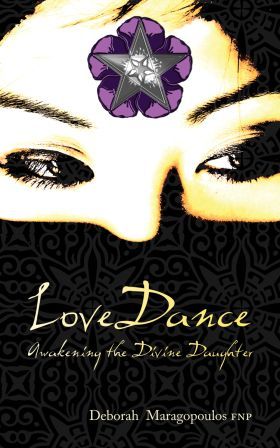
In the meantime LoveDance: Awakening the Divine Daughter – the book that healed the sacred feminine for me and many of my readers – is still available.
Love and Light,
Deborah Maragopoulos MN FNP
Intuitive Integrative Health
0 Comments