
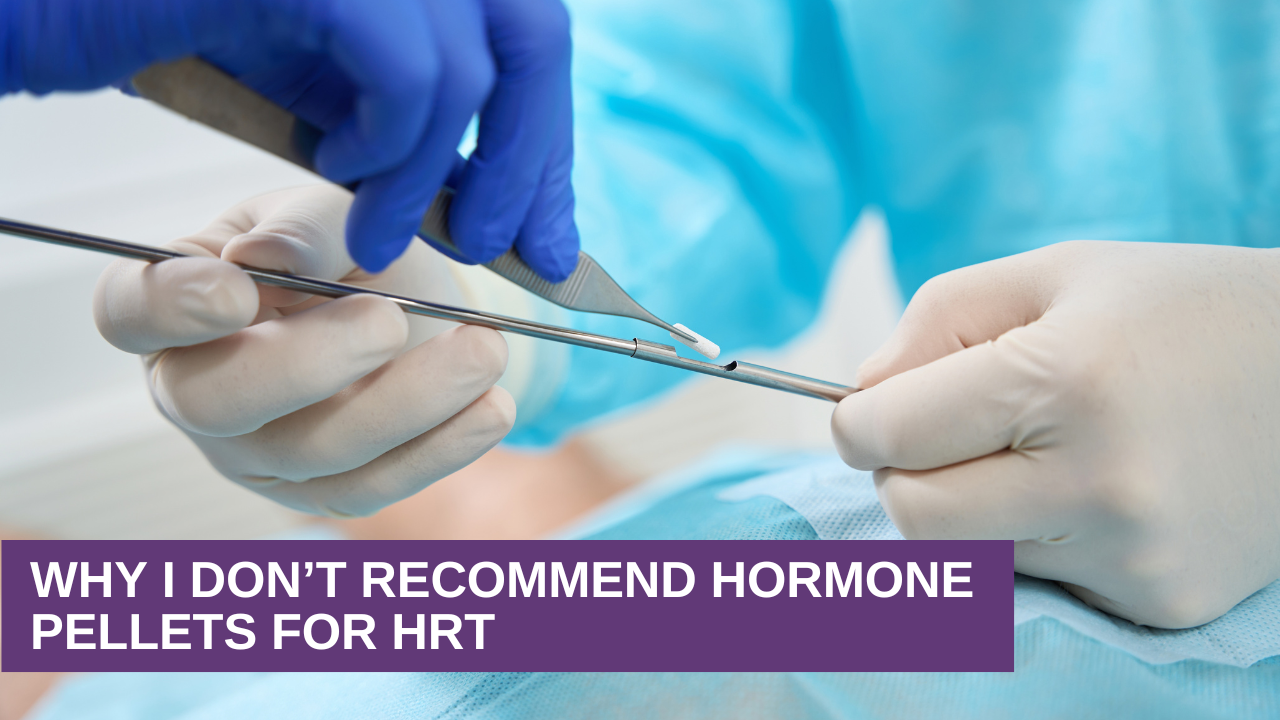
Pellets are hormones pressed into small cylinders that are injected under the skin. Pellets are similar to birth control implants in their delivery mechanism and are usually compounded.
Hormone pellets are meant to last three to five months and are inserted during an in-office procedure into the fat of the buttocks.
Twenty years ago, I had a few patients interested in trying pellets for hormone replacement therapy.
So I did a little research.
Pellets use bioidentical hormones, and are created in a compounding pharmacy, so I could individualize the dosing. Pellets weren't good at delivering progesterone, so we still had to use progesterone in a different form, usually transdermally.
Cons of Hormone Pellets for HRT
The issue I found with pellets is that first, you need to have them injected every few months.
Number two, we cannot control the amount of hormones you're going to absorb.
Even though pellets are compounded to the prescriber’s recommendation, some women’s bodies suck the hormones out quickly, giving them super high levels initially, which may give them extreme side effects, but then the effects wear off. Some women barely get any hormones from the pellets, and so it lasts a long time in their system. We can't control it. So if it's not going to work for you, you're stuck with those pellets until they dissolve, which could take three to five months.
One of the biggest issues with pellets is that they only contain testosterone and estrogen, no progesterone.
Progesterone is critical to protecting your tissues from the growth-promoting effects of estrogen, to help prevent cancer. Progesterone also supports adrenal function, which is critical to maintaining healthy hormone levels through postmenopause.
Testosterone in pellets tends to be a high dose, assuming the patient will convert it into estradiol. Not all do and become androgen dominant. High levels of testosterone in women cause an increase in facial and body hair, thinning of head hair, including male pattern baldness, weakness of ligaments and tendons leading to frequent joint injuries, mood disturbances with aggression and rage, elevated LDL cholesterol, and risk of arteriosclerosis.
Although I'm not a big fan of pellets as a form of hormone replacement therapy, it's an easy way for providers who don't know much about how to prescribe hormone replacement therapy to send their patients’ blood work to the pellet company and have the pellets compounded for that particular patient.
The problem is that blood work does not always reflect your hormone needs, determined by your symptoms, your risk factors, or your history. Your pituitary FSH and LH are more reflective of how much of each hormone you need at any particular point in the change.
I don't go by your blood levels of estrogen, progesterone, and testosterone to determine the dose of hormones you're going to need, because your tissue levels and what's floating around in your blood are two different things.
Since the dosages cannot be adjusted for at least three months, I don’t use pellets in my patients.
So what do I recommend?
- Hypothalamus Support is key to balancing all your hormones - sex steroids, adrenals, thyroid, pituitary and insulin. Start with Genesis Gold® 4gm for every role of body weight daily. My menopausal patients who take Genesis Gold® consistently detoxify their hormones safely and can use much less HRT.
- Micronized Progesterone is key for perimenopause and helps balance estrogen in menopause. I prefer transdermal formulations but because the absorption can be inconsistent, I recommend Gen-Pro™ - the same transdermal formula I created with my trusted compounding pharmacist and used in my patients for over thirty years. Gen-Pro™ is safe and highly effective. Dosages range from 50mg -200mg twice daily applied to the inner thigh for best absorption.
- Estradiol in sublingual or transdermal form. Doses are adjusted for symptom control. Estradiol available in pharmacies is bioidentical and usually covered by insurance. Estradiol combined with estriol can be compounded by a compounding pharmacy. Usual estradiol dosages range from 0.5mg - 2mg daily.
- Estriol Vaginal Cream for genitourinary symptoms like incontinence and vaginal dryness. Vaginal estriol is highly effective and can be compounded by a compounding pharmacy. Dosages are usually 1-2mg nightly for 6-8 weeks until vaginal atrophy resolves then estriol vaginal cream is used 2-3 times weekly for maintenance.
Deciding what type of HRT is best for you can be challenging.
In my Menopause Action Plan™ book, I highlight all your options to help you make the best decision.

What are the risks of hormone pellets for HRT?
Hormone pellets are small cylinders of compressed bioidentical hormones — typically testosterone and estradiol — that are inserted under the skin of the buttocks during an in-office procedure. They are designed to dissolve slowly over three to five months, releasing hormones steadily into surrounding tissue. Pellets are compounded at a pharmacy to a prescribed dose and have grown in popularity because of their convenience — no daily application or remembering a patch change. Unlike transdermal creams, patches, or oral hormones, pellets cannot be removed or adjusted once inserted, which is both their appeal and their most significant clinical limitation.
What are the risks of hormone pellets for HRT?
The most significant clinical concern with hormone pellets is that absorption rates vary unpredictably between individuals. Some women absorb hormones rapidly from the pellet, producing supraphysiologic levels initially that cause symptoms like bloating, breast tenderness, mood changes, and anxiety — followed by a drop in levels as the pellet depletes. Others absorb very slowly, meaning therapeutic levels are never reached. Because the pellet cannot be removed once inserted, there is no way to correct a problematic dose for three to five months. A second major issue is that pellets typically contain only testosterone and estradiol — not progesterone. Using estrogen without progesterone in women with a uterus increases the risk of endometrial hyperplasia and endometrial cancer. Progesterone must be prescribed separately, which many pellet protocols fail to address comprehensively.
Can hormone pellets cause high testosterone in women?
Yes — and this is one of the most commonly reported problems with pellet-based HRT. Pellets are frequently formulated with high testosterone doses on the assumption that the body will convert a portion of it into estradiol through aromatization. However, aromatization rates vary significantly between individuals — women who aromatize poorly end up with elevated testosterone and insufficient estrogen. High testosterone in women produces a recognizable cluster of symptoms: increased facial and body hair, thinning of scalp hair including male-pattern hairline changes, weakening of ligaments and tendons that increases injury risk, mood changes including irritability and aggression, elevated LDL cholesterol, and increased cardiovascular risk. Because the pellet cannot be adjusted once inserted, these effects persist until it dissolves.
Why don't hormone pellets include progesterone?
Progesterone is a large, fragile molecule that does not compress well into pellet form and does not absorb effectively through subcutaneous fat in the way testosterone and estradiol do. As a result, commercially available hormone pellets contain only testosterone and estradiol, and progesterone must be prescribed and administered separately — typically as a transdermal cream, oral micronized capsule, or vaginal preparation. This is a critical clinical gap because progesterone is essential for protecting uterine tissue from the proliferative effects of estrogen, for reducing breast cancer risk associated with estrogen therapy, for supporting adrenal function, and for its calming neurological effects via GABA production. A pellet protocol that does not actively address progesterone delivery is clinically incomplete.

0 Comments