
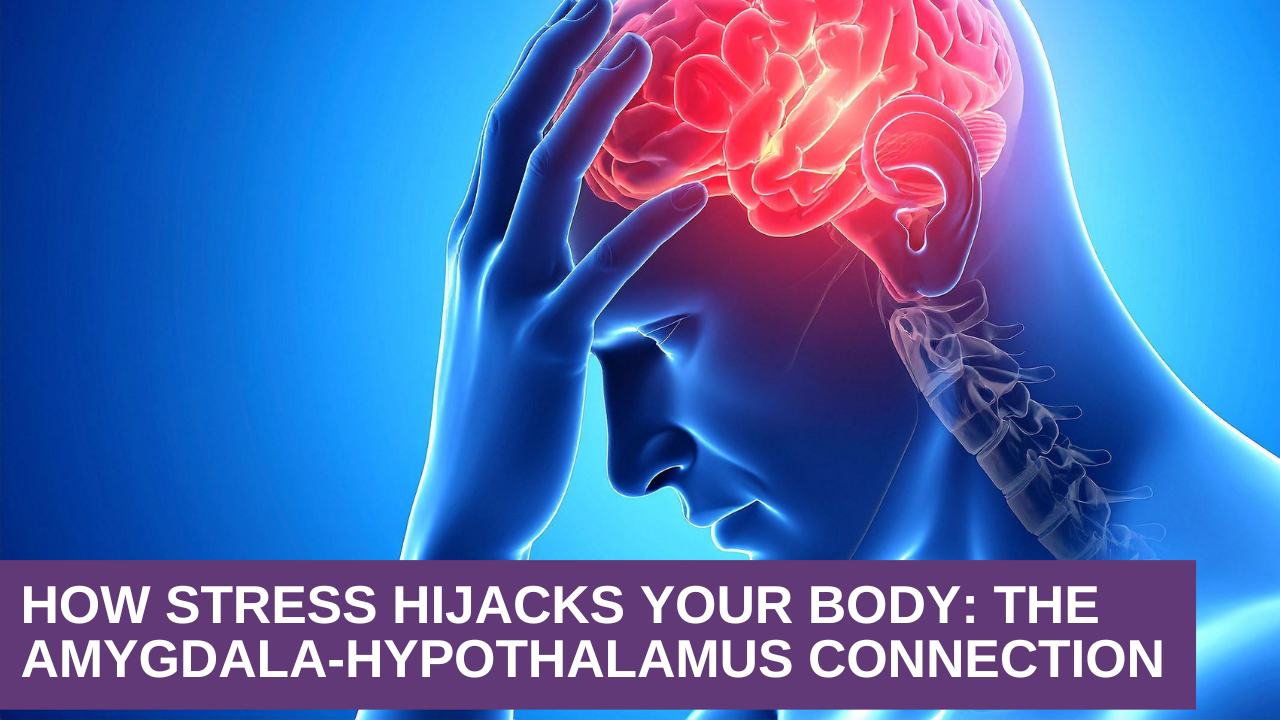
You’ve felt it before. You jump, your heart races, your breath catches, every muscle tenses. But only afterward do you realize, I wasn’t actually in danger. That response didn’t come from logic. It came from a conversation between two parts of your brain, your amygdala and your hypothalamus. Understanding how they work together explains why stress feels so physical, and why chronic stress is often hard to shut off.
The Amygdala and the Hypothalamus
When something stressful happens, your brain does not pause to analyze. It acts.
The amygdala processes emotional significance, especially threat. It scans your environment constantly.
The moment it perceives danger, it sends an alarm signal directly to the hypothalamus, and the hypothalamus is the command center.
It doesn’t ask, “Is this real?”
It asks, “Do we need to survive?”
And it responds instantly.
The Stress Response System
The hypothalamus communicates with the body through the autonomic nervous system, which controls involuntary functions like heart rate, blood pressure, breathing, blood vessel dilation, and digestion.
Think of this system as two pedals in a car. The sympathetic nervous system is the gas pedal, fight or flight. The parasympathetic nervous system is the brake, rest, and digest.
When the amygdala sounds the alarm, the hypothalamus slams on the gas.
What Happens in the Body During Stress
Here’s what happens in your body in a matter of seconds before conscious thought even registers.
Once activated, the hypothalamus sends signals through autonomic nerves to the adrenal glands.
The adrenals release adrenaline. Heart rate increases. Blood pressure rises. Breathing speeds up. Airways open wider. Blood rushes to muscles and vital organs. Blood sugar and fats release for quick energy. Senses sharpen.
All this happens before you think.
That’s why someone can jump out of the way of a car before they even register seeing it.
The system evolved to save your life, and it’s brilliant at it.
When Stress Becomes Chronic
Now, here’s where it all goes from life-saving to life-disrupting.
If the brain continues to perceive threat, whether physical, emotional, financial, relational, or internal, the hypothalamus activates a second system, the HPA axis.
The hypothalamus releases corticotropin-releasing hormone, and the pituitary releases ACTH.
The adrenals release cortisol.
Cortisol keeps the gas pedal pressed down.
This is helpful short-term, but when stress becomes chronic, the body never fully returns to baseline. An engine that idles too high for too long starts to break down.
Persistent stress chemistry damages blood vessels and arteries. Blood pressure stays elevated. Cardiovascular risk increases. Appetite rises. Fat storage increases, especially around the abdomen. Sleep fragments. Digestion slows. Immune regulation weakens.
The body isn’t malfunctioning.
It’s doing exactly what it was designed to do: stay ready for danger.
The problem is that modern stress rarely resolves cleanly.
There’s no tiger-is-gone moment.
The cortisol just keeps flowing.
Restoring Balance
The goal is not to eliminate stress.
The goal is to restore braking capacity.
When the parasympathetic nervous system can engage again, cortisol falls, digestion resumes, sleep deepens, and the nervous system recalibrates.
This happens through:
- Predictable rhythms
- Adequate nutrition
- Stable blood sugar
- Restorative sleep
- Emotional safety
- Nervous system regulation
Healing doesn’t come from forcing calm.
It comes from restoring balance between the amygdala and the hypothalamus.
Final Thoughts
Now, if you want to understand how the stress cascade connects to hormone healing, sleep, weight, and immune function, my free Hormone Reboot Training walks you through the full picture.
Your stress response isn’t weakness.
It’s a survival system that learned to stay on too long.
And when the body learns it’s safe again, the brakes come back online.


0 Comments