
If you lead a team, manage a business, or drive results for a living… You already know your well-being affects everything. When you’re balanced, your business flows. When you’re out of alignment, things break down — including your health.
Let me tell you a story about what’s possible when you support the part of your body that most people never even think to heal.
Patient Story
I had a patient — a regional manager for a major pharmaceutical company.
On paper, she had made it.
But underneath? She was barely holding it together.
This patient was:
- On insulin for diabetes
- Taking sleep meds, antidepressants, anti-anxiety meds
- Using cortisone and thyroid hormones
- Exercising obsessively and dieting severely just to maintain her weight
- Not detoxing or digesting well
- Losing hair, constantly sick, chronically stressed…
- And she’d never had a menstrual cycle.
She had something called panhypopituitarism, which meant her brain wasn’t producing the hormones needed to run her endocrine system.
I started by transitioning her to natural therapies — bioidentical hormones, botanicals, homeopathics.
And she started feeling better — but not well.
It was still a complicated stack of support. And she was still dependent on external inputs.
Then I said…
“What if we could wake up your hypothalamic-pituitary axis — and let your body run the show again?”
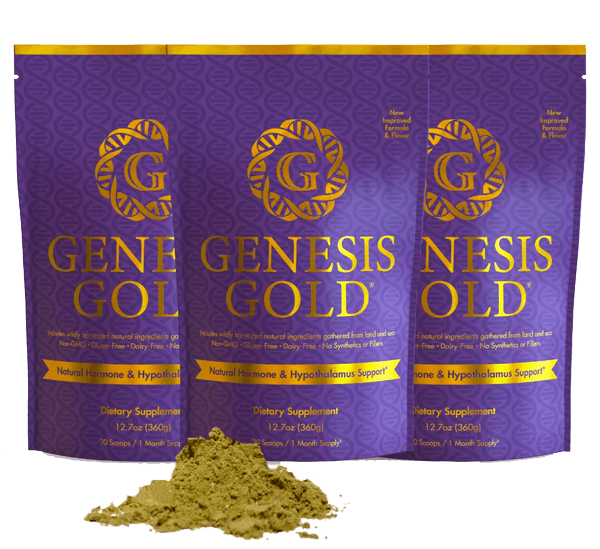
She agreed to try Genesis Gold® — my nutraceutical blend designed to support the hypothalamus directly.
Everything Changed with Genesis Gold®
Over the next 18 months:
- She weaned off all her hormones — thyroid, adrenal, even insulin.
- Her digestion normalized.
- Her anxiety and depression lifted — no meds required.
- Her energy returned.
- And… for the first time in her life, she started having natural cycles.
By age 43 — this woman who had been told she was infertile her entire life — gave birth to a healthy baby boy.
Her region’s sales? They boomed.
Her leadership? Clear, calm, magnetic.
She finally found work-life balance — not by pushing harder, but by supporting herself at the root.
And here’s the bigger picture:
You don’t have to be that extreme case to benefit from hypothalamic support.
Most leaders — most high performers — are already on the edge.
We’re:
- Overstimulated
- Undernourished
- Battling environmental toxins
- And genetically mismatched to the nutrients in our soil and food
Even with the best organic diet and lifestyle, most of us can’t get the full range of phytonutrients our hypothalamus needs to regulate our hormones, metabolism, mood, and energy.
That’s why I created Genesis Gold® — with ingredients sourced from around the world, to match the genetic diversity of the modern human.
It’s not just about feeling good.
It’s about reclaiming who you really are — before the stress, the exhaustion, and the hormones got in the way.
If you’re a leader who wants to show up with clarity, calm, and energy — without sacrificing your health or your intuition — it’s time to support your hypothalamus.
That’s what I teach you to do in my free Hormone Reboot Training.
Because when your system is aligned, your business flows.
And when you’re operating from balance — you become unshakable.
What does the hypothalamus do in the body?
The hypothalamus is a small but extraordinarily powerful region of the brain that serves as the body's master control center for hormonal and autonomic function. It regulates the production and release of hormones from the pituitary gland, which in turn directs the thyroid, adrenal glands, ovaries, and testes. Beyond hormones, the hypothalamus also governs body temperature, hunger, thirst, sleep-wake cycles, circadian rhythms, metabolism, immune function, and emotional regulation. It receives constant input from every system in the body — including the gut microbiome, fat cells, and nervous system — and adjusts hormonal output accordingly. When the hypothalamus is well-nourished and functioning optimally, it orchestrates the entire endocrine system with precision. When it is depleted, overstimulated, or undernourished, the downstream effects touch virtually every aspect of health.
What are the signs that your hypothalamus needs support?
Signs that the hypothalamus is struggling often look like a collection of seemingly unrelated symptoms that conventional medicine tends to treat individually rather than at the root. Common indicators include persistent fatigue that doesn't resolve with rest, disrupted sleep or difficulty staying asleep, unexplained weight gain or an inability to lose weight despite diet and exercise, temperature dysregulation such as feeling consistently too hot or too cold, hormonal imbalances including irregular cycles, low libido, or perimenopausal symptoms that feel disproportionately severe, mood instability including anxiety and depression, chronic stress reactivity, poor digestion, hair loss, and blood sugar irregularities. Because the hypothalamus coordinates so many systems simultaneously, dysfunction tends to show up as a pattern of multi-system complaints rather than a single isolated condition. If you recognize several of these symptoms together, it is worth considering whether hypothalamic support is the missing piece.
What is panhypopituitarism and how does hypothalamic support help?
Panhypopituitarism is a rare but serious condition in which the pituitary gland fails to produce adequate levels of most or all of its hormones, typically because the hypothalamus is not sending the proper signaling hormones to activate pituitary function. People with panhypopituitarism are usually placed on multiple hormone replacement therapies simultaneously to compensate for what the body is not producing on its own — including thyroid hormone, adrenal hormones, sex hormones, and sometimes growth hormone. Conventional treatment manages the symptoms but does not address the upstream signaling dysfunction. When hypothalamic function can be supported and restored at the root level, the pituitary may regain its ability to communicate with downstream glands more effectively, potentially reducing dependence on exogenous hormone replacement over time. This is why deep hypothalamic nourishment — rather than symptom-by-symptom hormone supplementation — can produce results that standard protocols alone cannot.
How do you support the hypothalamus naturally?
Supporting the hypothalamus naturally requires addressing the inputs it depends on to function correctly: targeted phytonutrients, stable blood sugar, quality sleep, stress regulation, and reduction of environmental toxin burden. The hypothalamus is uniquely sensitive to nutritional depletion because it must constantly synthesize and regulate a wide range of neuropeptides and signaling hormones. A plant-rich diet with adequate healthy fats and protein provides a foundation, but modern food supply limitations — including soil depletion and reduced phytonutrient density — mean that even a well-designed diet often falls short of what the hypothalamus needs. Chronic stress is one of the most significant disruptors of hypothalamic function, as sustained cortisol elevation directly impairs the hypothalamic-pituitary-adrenal axis. Prioritizing seven to nine hours of quality sleep, practicing stress reduction techniques, and minimizing exposure to endocrine-disrupting chemicals all reduce the burden on the hypothalamus. Nutraceutical support with phytonutrients specifically selected for hypothalamic nourishment — such as those found in Genesis Gold® — can provide what diet alone may not be able to deliver.

0 Comments