
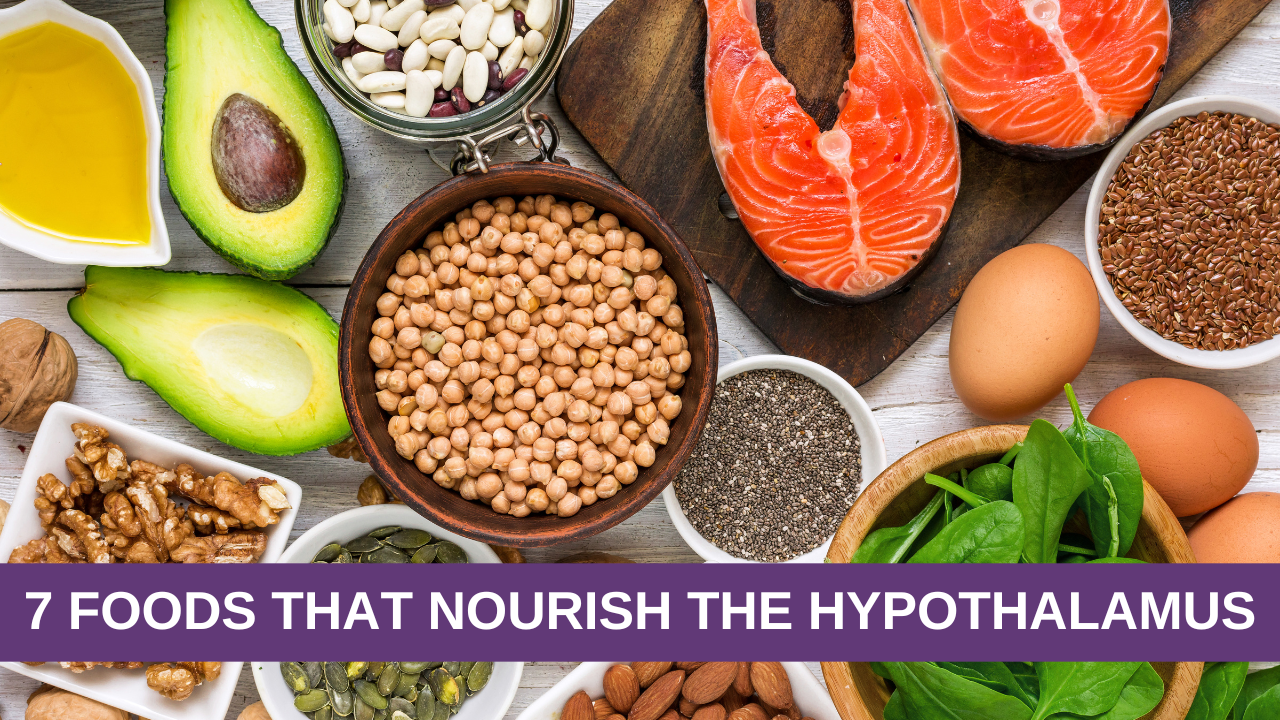
If you want to know what foods help nourish the hypothalamus, then this is for you.
I’m going to show you seven foods that support your hypothalamus, why this tiny gland needs the right nutrients to function, and how what you eat can affect your hormones, mood, sleep, metabolism, and stress response.
Your Hypothalamus is the Master Controller of Your Hormones
It sits in the center of your brain, and its job is to read what is happening in your body and help keep you in balance.
- It helps regulate your sleep
- Your appetite
- Your body temperature
- Your stress response
- Your metabolism
- Your blood sugar
- Your moods
- Your memory
- Your immune system
And all of your hormone communication.
But here is the important part.
Your hypothalamus is very sensitive to what is in your bloodstream.
It is reading your nutrients. Your blood sugar. Your hydration. Your stress hormones. Your inflammation. Your toxins. Your gut signals.
So if you are not eating the nutrients your hypothalamus needs, it can become harder for your body to stay hormonally balanced.
This is why food matters.
Not because one perfect food fixes everything.
But because the right foods send better signals to your hypothalamus.
So let’s talk about seven foods that nourish the hypothalamus.
#1: Protein-Rich Foods
Your hypothalamus needs amino acids.
Amino acids come from protein, and they are the building blocks your body uses to make hormones, neurotransmitters, enzymes, tissues, and immune factors.
If you are not eating enough protein, your body may not have what it needs to make the brain chemicals that affect your mood, motivation, focus, and sleep.
So protein is foundational.
That can look like eggs, fish, chicken, turkey, grass-fed meats, Greek yogurt, cottage cheese, legumes, tofu, tempeh, nuts, and seeds.
Pay Attention to Breakfast
A lot of hormonally challenged women skip breakfast because they are not hungry in the morning.
But if your blood sugar is unstable, skipping breakfast can stress your hypothalamus.
Start your day with protein.
Protein tells your hypothalamus, “We have fuel. We have building blocks. We do not need to panic.”
#2: Omega-3 Rich Foods
Your hypothalamus needs healthy fats, especially polyunsaturated fatty acids.
Omega-3 fats help support brain health, healthy cell membranes, and a balanced inflammatory response.
And your hypothalamus is part of your brain, so it needs healthy fats to communicate well.
Omega-3 rich foods include salmon, sardines, mackerel, trout, anchovies, chia seeds, flaxseeds, hemp seeds, and walnuts.
These fats help your cell membranes stay flexible so hormones and neurotransmitters can communicate more effectively.
If your cell membranes are stiff or inflamed, hormone signaling becomes harder.
So if you want better hormone communication, do not be afraid of healthy fats.
Your brain needs them.
#3: Sea Vegetables
Sea vegetables are one of the foods most people forget about.
But sea vegetation contains minerals, trace nutrients, and plant compounds that can support the hypothalamus, thyroid, metabolism, and hormone balance.
This can include seaweed, kelp, nori, dulse, wakame, and other edible sea vegetables.
Now, you do not need a lot.
And if you have thyroid disease or iodine sensitivity, you should talk with your healthcare provider before adding large amounts of seaweed or kelp.
But in small food amounts, sea vegetables can be a beautiful way to add minerals that are often missing from the modern diet.
Your hypothalamus is reading whether your environment is nourishing or depleted.
Mineral-rich foods help send the message that your body has resources.
#4: Colorful Vegetables and Fruits
Your hypothalamus loves phytonutrients.
Phytonutrients are plant compounds that help protect your cells, support detoxification, calm oxidative stress, and help your body communicate better.
The colors in vegetables and fruits are where many of these protective compounds are found.
Eat the Rainbow:
- Purple cabbage
- Blueberries
- Pomegranate
- Red peppers
- Tomatoes
- Carrots
- Pumpkin
- Leafy greens
- Broccoli
- Beets
- Berries
These colorful plant foods help give your body antioxidants and micronutrients.
And remember, your hypothalamus is sensitive to inflammation and oxidative stress.
When your diet is low in plant foods and high in sugar, starches, processed oils, and fake foods, your hypothalamus does not get the signal that your body is safe and nourished.
Colorful plants help change that message.
#5: Cruciferous Vegetables and Sprouts
Cruciferous vegetables are especially important for hormone balance.
This includes broccoli, cauliflower, brussels sprouts, cabbage, kale, arugula, bok choy, and broccoli sprouts.
These foods contain plant compounds that support healthy estrogen metabolism, detoxification, and cellular protection.
And that matters because your hypothalamus is constantly communicating with your ovaries, adrenals, thyroid, pancreas, and liver.
If your body is struggling to metabolize hormones properly, your hypothalamus has to keep responding to mixed signals.
Cruciferous vegetables help your body process hormones more cleanly.
Broccoli sprouts are especially powerful because they are concentrated in protective plant compounds.
You can add them to salads, eggs, wraps, soups, or protein bowls.
#6: Healthy Fats from Olive Oil, Avocado, Nuts, and Seeds
Your hypothalamus needs healthy fats, but the kind of fat matters.
The standard American diet is often too high in damaged fats, trans fats, fried foods, and processed oils.
Those fats can increase inflammation.
But whole food fats and Mediterranean-style fats can support healthy cell membranes and hormone receptor sites.
That means olive oil, avocado, walnuts, almonds, pumpkin seeds, chia seeds, flaxseeds, hemp seeds, and olives.
Olive oil is one of my favorite fats because it is rich in anti-inflammatory compounds and works beautifully with vegetables.
Drizzle olive oil over cooked vegetables.
Add avocado to your protein.
Use nuts and seeds on salads.
These healthy fats help you feel satisfied, stabilize blood sugar, and support your hormones.
Remember, your hormones need fat.
Your brain needs fat.
Your hypothalamus needs fat.
#7: Gut-Supportive Foods
Your gut and hypothalamus are always talking to each other.
So if your gut is inflamed, constipated, bloated, or out of balance, your hypothalamus may read that as stress.
That is why gut-supportive foods are so important.
This includes high-fiber foods and probiotic-rich foods.
High-fiber foods include vegetables, berries, beans, lentils, artichokes, asparagus, chia seeds, flaxseeds, and whole plant foods.
Probiotic-rich foods include plain yogurt, kefir, sauerkraut, kimchi, miso, and fermented vegetables.
These foods help support your microbiome, digestion, detoxification, immune system, and hormone metabolism.
And when your gut sends better signals, your hypothalamus has less stress to manage.
Nourish the Hypothalamus
If you want to nourish your hypothalamus, focus on:
- Protein-rich foods for amino acids
- Omega-3 rich foods for healthy brain fats
- Sea vegetables for minerals and unique phytonutrients
- Colorful vegetables and fruits for antioxidants
- Cruciferous vegetables and sprouts for hormone metabolism
- Healthy fats like olive oil, avocado, nuts, and seeds for cell membranes and hormone signaling
- And gut-supportive foods with fiber and probiotics
This is not about eating perfectly.
It is about giving your hypothalamus the raw materials it needs to do its job.
Because your hypothalamus cannot regulate your hormones, stress response, sleep, metabolism, appetite, mood, and immune system without nourishment.
If you are dealing with hormone symptoms, menopause symptoms, brain fog, belly fat, poor sleep, cravings, mood swings, or feeling like your body is out of balance, your hypothalamus may need more support.
That is why I created my free Hormone Reboot Training to help you understand how to support your hypothalamus and bring your hormones back into balance naturally.
And tell me in the comments: which of these hypothalamus-nourishing foods do you already eat?


0 Comments