
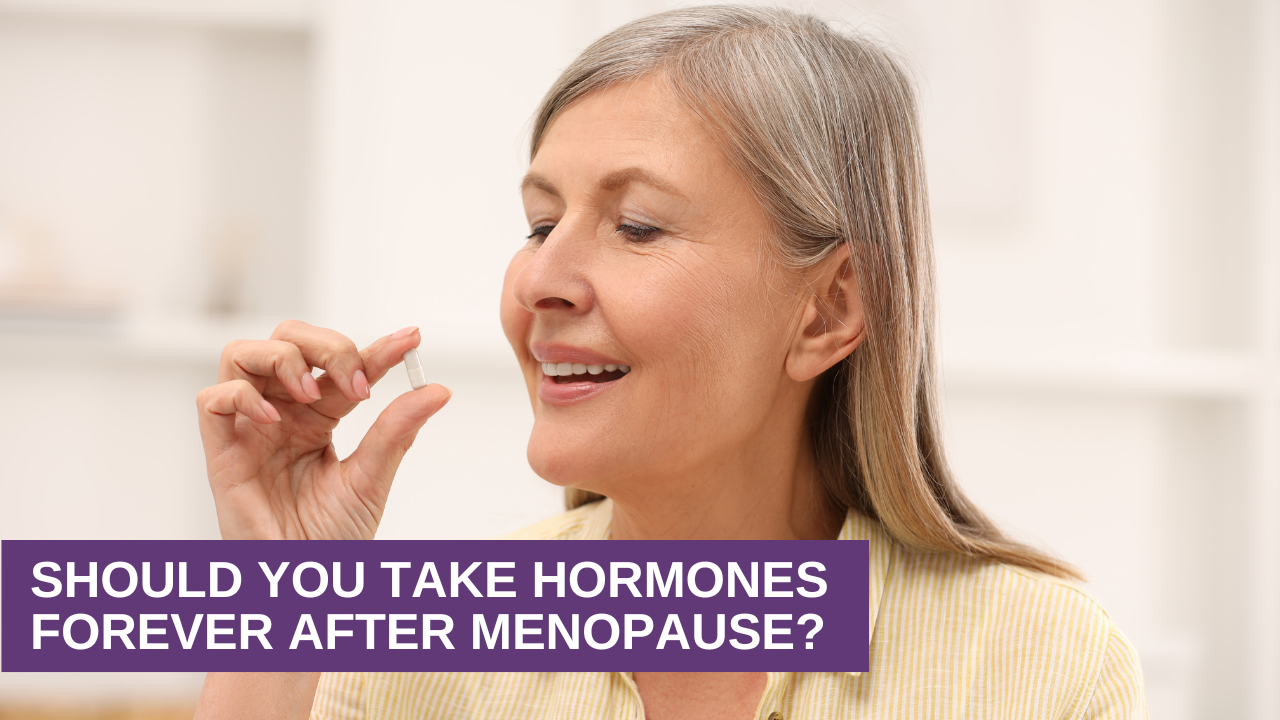
Do you have to take hormones forever after menopause?
Using hormones past menopause is an individualized decision. Let’s talk about the pros and cons.
Using HRT in your senior years is a very individual decision, and you need to take into account your genetics, family history, and your current and past lifestyle. Every woman is different.
I had a couple of patients who would come to my office together, one in her late 70s, the other in her early 80s. Both were using hormone replacement therapy systemically, as well as vaginal estrogen, because they were both sexually active. In fact, they were single women who liked to go to bars together. They would arrive in my office to make sure that their vaginas were nice and healthy before they would go out.
It’s not my decision as a health care provider; how long you want to use hormones is your decision.
Hormones After Menopause
Can you start hormone replacement therapy if you’re postmenopausal? Absolutely. If you went through menopause and didn't use any hormones and now you have osteoporosis, an incredibly dry vagina, and you want hormones, you can absolutely start them.
We just need to make sure that you don't have active breast cancer, so we may do breast imaging to be sure that HRT will be safe for you. And even if you do have breast cancer, you can still use some vaginal estrogens. Older women may need hormone replacement therapy, and should be given the opportunity to discuss the risks and benefits with their health care provider.
Are you going to have more issues if you initiate hormone replacement therapy when you're older? Well, if you haven't had estrogen on board for 20 years, estrogen will wake up certain body parts. Because of this, you're going to be more susceptible to estrogen-related side effects like bloating, breast tenderness, and vaginal discharge.
Even if you’re 80 years old and you take enough estrogen, your uterus lining can be stimulated, meaning you might bleed. Your tissues are still alive and viable, and hormones can bring them out of hibernation.
So you want to start out very low and slow when you first initiate hormones if you've been menopausal for more than 10 years. If you’re well into postmenopause, we're going to gradually titrate your dose to reduce symptoms. You don't necessarily need high doses to get a good effect.
Risks
While there is always a potential that if you use hormones between the ages of 60 and 70, you may have some increased risk for breast cancer, the risk is different for every woman. So I make it an individual decision for each woman, and we do the appropriate screenings for breast cancers. We check bone density with a DEXA scan, and make sure that she's not actively losing bone with a urine cross-link test. We check the rest of her hormones too.
I like to look at a woman in terms of her biological age, not her chronological age. For instance, I was born in 1961, so my chronological age in 2021 is 60. However, biologically, my biochemistry is more like 45. So am I going to take hormones longer? Probably, because I don't have the metabolism of a 60 year old. I have the metabolism of a 45 year old.
Every Woman is Different
Health care providers should consider each as an individual, and not assume that just because a woman falls into an age group that she’s no longer a candidate for hormone replacement therapy. Of course, once you're done with HRT, you can stop. But it isn’t wise to stop suddenly. Slowly come down, because it'll be a shock to your system and will feel like you're going through menopause all over again.
One way that you can use hormone replacement therapy for long periods of time, well into postmenopause, is by giving yourself hypothalamic support. If you decide you're going to support your hypothalamus with Genesis Gold®, it's going to increase your cell receptor site activity, so you can use less hormone replacement therapy. That’s why the dosages I recommend for HRT are much lower than typical dosages, because the majority of my patients are supporting their hypothalamus with Genesis Gold®. They can use a lot less hormones and get the same or better results.
Support Your Hypothalamus
When you support your hypothalamus, you're improving communication between the hormones you're taking, like sex hormones – estrogen, progesterone and testosterone – and your hypothalamus and pituitary. Supporting your hypothalamus also improves communication between all your other hormones. Using Genesis Gold® helps improve adrenal function, supports growth hormone production, and even supports other pituitary hormones, like oxytocin, so you have better orgasms. It also improves your brain function, your immune function, and reduces the symptoms of menopause.
If you have any questions, please join us in our free Hormone Reboot Training.
Do you have to take hormones forever after menopause?
No — how long to use hormone replacement therapy after menopause is an individualized decision, not a universal protocol. Some women use HRT for a few years to manage the transition through perimenopause and early postmenopause, then taper off. Others choose to continue long-term for quality of life, bone protection, cardiovascular health, and cognitive support. The right duration depends on personal health history, genetics, symptom burden, biological age, and individual risk factors — not on a calendar cutoff. Current evidence no longer supports the once-common recommendation to limit HRT to five years; many professional societies now acknowledge that for healthy women who began HRT early in the menopausal transition, continued use is reasonable with regular reassessment. The decision belongs to the woman and her healthcare provider, not to a one-size-fits-all guideline.
Is it safe to start HRT years after menopause?
Yes — it is possible to initiate hormone replacement therapy well into postmenopause, though the approach differs from starting at perimenopause. Tissues that have been without estrogen for many years are more sensitive to its effects, so the standard recommendation is to start at a very low dose and increase gradually to minimize side effects like bloating, breast tenderness, and vaginal discharge as the body readjusts. Even women in their 70s and 80s can benefit from HRT — particularly for genitourinary health, bone density, and quality of life — as long as active contraindications such as current breast cancer are ruled out. Appropriate screening, including breast imaging and bone density assessment, guides the decision. The key clinical shift is thinking about biological age and current health status rather than defaulting to chronological age as a disqualifier.
What is the difference between bioidentical and synthetic HRT?
Bioidentical hormones are chemically identical in structure to the hormones the human body naturally produces — including estradiol, progesterone, and testosterone. Synthetic hormones, such as conjugated equine estrogens (Premarin) and medroxyprogesterone acetate (Provera), have different molecular structures that interact with hormone receptors differently. The 2002 Women's Health Initiative study that generated widespread fear of HRT used synthetic oral hormones — specifically conjugated equine estrogen combined with synthetic progestin — and the risk findings from that study do not directly translate to bioidentical transdermal estrogen and natural progesterone, which have a different metabolic and safety profile. Bioidentical transdermal estrogen avoids the first-pass liver metabolism of oral hormones, which is associated with increased clotting risk, and natural progesterone does not carry the same breast cancer risk signal as synthetic progestins. The distinction matters significantly when evaluating long-term HRT decisions.
Im a healthy (i think) 50 year old experiencing several hot flashes a day , sometimes 2 or more an hour, sometimes longer, always freezing as it passes. Im so tired of being drenched in sweat. As a woman whos already passed Mena pause, last period was more than 3 years ago, who am I still experiencing such god awful hot flashes as well as very sleep disturbing night sweats? And why such severe in nature? Its as if someone lights a match, sticks it in my brain and I catch fire on the inside all the way down to my toes only to end up shivering with cold in the same breath? I dont think I can take mych more, every aspect of my life is being affected including how mych rest im actually getting. I am very physically active also. And I think sometimes maybe too physical given my new status as “older” as im finding im reference to now that im past the so called “50’s” marker.
I do not feel like a 50 year old. I very much liked the part where you describe differences in biological age and chronological. I think its important to note while I may be 50, I feel like im 35-40. And happy about this as I have not lived my life fully yet and still want more and to do more. Am I crazy? Lol… maybe not yet, but the hot flashes may make me that way! Thanks for helping women like us!
I have helped hundreds of women with similar symptoms get their life back by supporting their hypothalamus.
Here’s more information https://genesisgold.com/menopause-lp/