

You know what I mean by the hormone roller coaster. You feel like your hormones are out of balance, and you’re feeling physically and emotionally stressed. And by hormones, I don't just mean your sex hormones. I’m talking about all of your hormones – thyroid, adrenal, pituitary, pancreas, and the rest. Many don’t know this, but your first hormonal transition began when you were in your mother's womb. As a fetus, you were exposed to the highest level of hormones, which promoted your growth from a little zygote to a full-term baby. In childhood, your hormone levels flatten out, but during puberty, everything starts turning back on again at a high level.
The first thing to turn on during puberty are your adrenal glands. They produce the DHEA that helps you develop your secondary sex characteristics, like breast buds in girls, and body hair in boys. Only after your adrenal prime does the pump to your gonads turn on. Girls get menstrual periods. Boys have nocturnal emissions, or wet dreams. Around two years months after gonads turn on, you reach your peak of human growth hormone production by the pituitary gland. And finally, you start to produce your adult level of thyroid hormone that will maintain the metabolism for your body.
In adulthood, except for during pregnancy, hormones level out for about 20-30 years until you reach the change.
More recently, the change is starting to happen a lot earlier for women. It used to be typical that in your 40s, you would start perimenopause, and by 51(on average), you would stop having periods as you enter menopause. But now, women are starting perimenopause in their 30s. By your mid-30s, you just don't have as many eggs, so you're not producing as much estrogen and you're definitely not producing as much progesterone.
During perimenopause, it may seem like puberty all over again, but with wrinkles. Your hormones are all over the place, and just as they come in, they go out. First, the adrenals begin to wane in their production of DHEA, which is super important as it controls your protein and fat metabolism, helping you heal and repair tissues. After this, your ovaries start faltering with less progesterone production, then less estrogen production, and then finally testosterone production falls. Then, your pituitary starts making way less growth hormone, so you're no longer building muscle and bone. You’ll start to notice yourself getting fatter, no matter how much you exercise or what you're eating. And finally, your thyroid gets really low, and your metabolism slows way down.
The hormonal roller coaster is a part of life, which is why it’s important that we make some kind of plan for ourselves on how to deal with it. When you were young, you were probably given some kind of education about what to expect as your body was changing. Yet, nobody gives you any kind of education as you're going through the change.
Right now, you may be comparing notes with other women and reading stuff in magazines, but you don't get any kind of official education about what to expect when you begin the change. If you don't know how to get your hormones in balance, and how to support yourself through this process, you stay vital and healthy. You’ll develop chronic illnesses that’ll decrease your quality of your life. This is why it’s super important to have a MAP – a Menopause Action Plan. Your MAP is how you can successfully navigate through the change, so that you’re thriving, not just surviving.
If you’re interested in learning more, download my free guide to the Menopause Action Plan.
Did you know that your hormone story began when you were in your mother’s womb?
That’s right. In order to grow from a fertilized egg to a newborn baby, you need hormones. Lots of them. And then after birth, your hormones are in stealth mode.
That is until they reach puberty. Then you are on the hormonal roller-coaster.
Until you reach the age of the pause — menopause for women, andropause for men — unless stress wears you out earlier, then you get to get back on the hormonal roller-coaster. You know the one!
You can’t sleep. You have no energy. You’re moody. You can’t focus.
Let me explain.
As a growing fetus your hormones were higher than they will ever be again. All those hormones helped you grow from a tiny zygote to a newborn baby. At birth, you entered a hormonal slump. Although growth occurs, hormones are naturally low in childhood. But at puberty, your hormones entered a fantastic roller-coaster.
First your adrenals started pumping out high levels of DHEA—a hormone needed to metabolize protein and fat for you to grow rapidly. DHEA converted to testosterone and hair began sprouting on your body and you developed body odor. DHEA then converted to estrogen and your breasts budded. A couple of years later, your ovaries woke up and you had your first period.
During this time your pancreas began pumping out glucagon to release stored baby fat and insulin to fuel your pubescent growth. A couple years after your first period (or first nocturnal emission if you're male), your growth hormone levels peaked and you reached your full adult height. Then your thyroid hormone levels reached a plateau to maintain your new young adult metabolism.
Perimenopause and andropause (the male version) both follow the same pattern as puberty, but in the opposite direction!
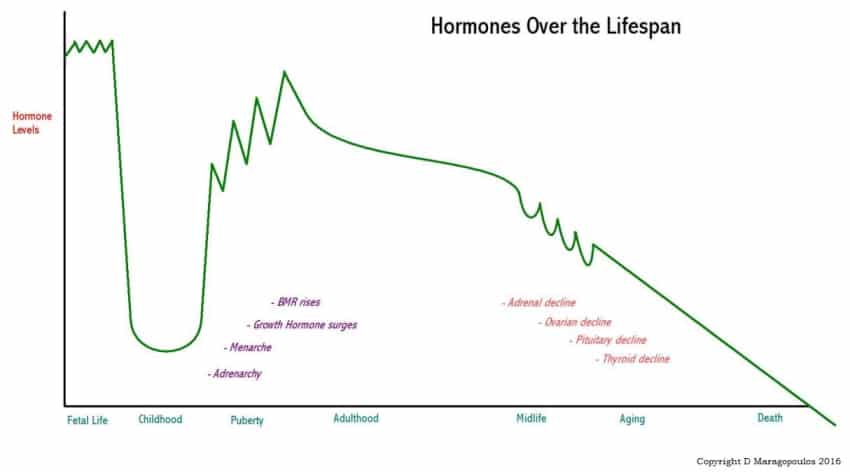
As we came in thus we go out...
First your adrenals falter. Stress greatly affects you and you get tired easily.
Then your ovaries slow down. Your periods become heavier, irregular, you begin skipping periods. You become moody, irritable, and forgetful. Then fat! Because your pancreas is producing more and more insulin to keep up with the Change and eventually you become insulin resistant.
Then your growth hormone levels drop and you just don’t heal as quickly. You do not recover from exercise or a late night out like you did when you were younger.
Finally, your thyroid slows way down. Why? Because you cannot have a high metabolism with low hormones. You would literally implode.
The key to balancing hormones is supporting your hypothalamus. Your hypothalamus is the maestro of your entire symphony of hormones. Rather than tuning all the instruments - thyroid, adrenals, ovaries, pituitary - I focus on balancing your hypothalamus.
That's why I created:
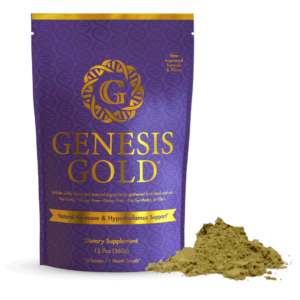
Genesis Gold - the only plant based complete hypothalamic support plus phytonutrients to support all your hormones.*
I keep my Hormones in Harmony® and optimize my health and metabolism by taking Genesis Gold®.
So even the Pause is just another Joyous Transformation!
May your Hormones be in Harmony,
Deborah Maragopoulos MN FNP
Intuitive Integrative Health
*Statements not evaluated by the FDA

Please tell me if this helps during menopause
My estradiol is <11 and FSH is 109
I am 45 and have not had a period in two years…and I'm miserable.
Energy, night sweats, cannot think clearly, no desire at all for intimacy, etc.