
In the wee hours before the dawn of Memorial Day, I was awakened by a sick dog. I jumped out of bed to remedy the situation. Sitting down in a pose I’ve done a thousand times, I leaned slightly forward to assess the poor pooch and…a searing pain shot through my left flank around my waist and into my groin. My back was in complete spasm. My husband had to lift me off the floor.
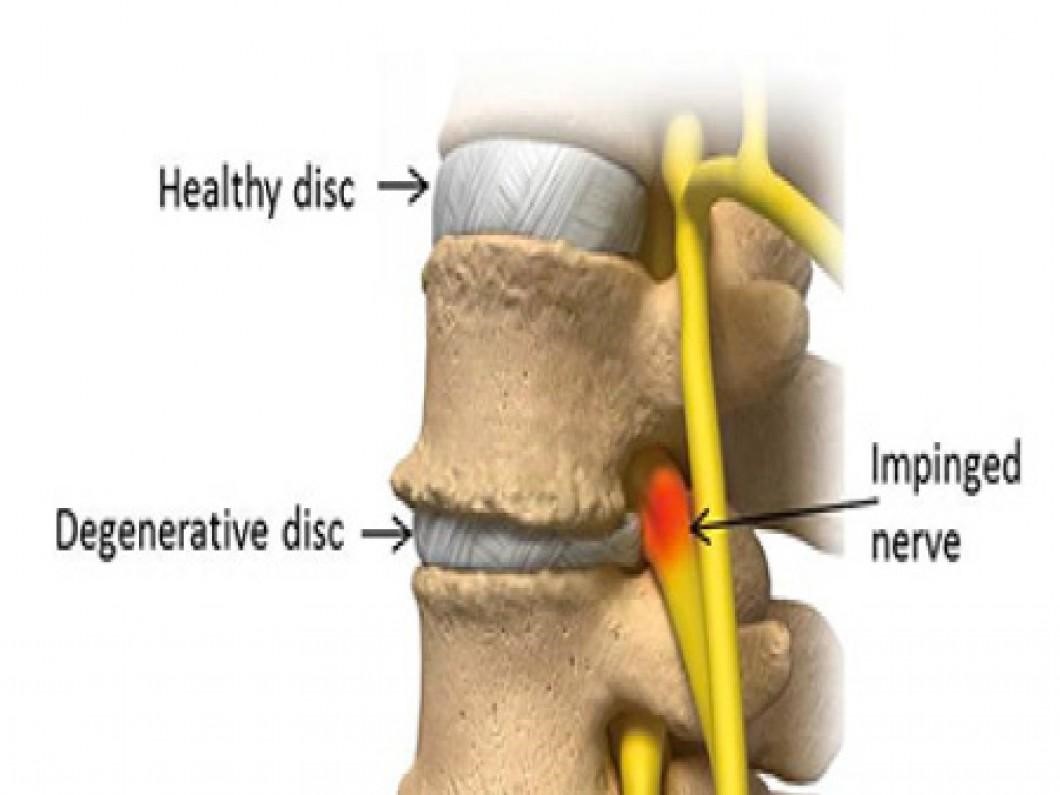
I immediately iced the injury. By dawn I could barely move. So I went to the chiropractor who applied heat, massaged my muscles, and adjusted my spine. Then he fit me with a back brace. I got an X-ray, which led to an MRI which revealed degenerative disc disease with an annular tear and right nerve impingement.
Hmmm. My severe left back pain was from the muscles trying desperately to splint my vertebrae to keep my forward bend from injuring the nerve root which innervates my right leg. I’ve had sciatica ever since with numbness and tingling down to my right foot.
To avoid surgery, I started a vigorous healing regimen of heat/ice, realignment exercises, inversion therapy, massage, acupuncture, and physical therapy. Plus nutraceuticals to help reduce inflammation and rejuvenate my discs.
So what causes degenerative disc disease?
The wear and tear of age accelerated by high impact activities. The bones that make up the spine are called vertebrae. The vertebrae are held in place by discs which are circular ligaments filled with shock-absorbing gelatinous material. The spinal cord runs through the vertebra with the nerve roots coming off the spinal cord on both the left and the right side between each and every vertebrae. The spinal nerves innervate your body both stimulating movement and sensation. Any pinching of a nerve can cause pain.
Slight pinching affects sensation. More pinching affects movement. And if the nerve impingement or pinching goes on too long, you can lose function of the body part that nerve controls.
I’m a super active person. But unless I count making appointments for physical therapy, acupuncture, and massage as physical activity...my workouts are limited to walking—which thank goodness feels good.
There is definitely a pattern.
It seems like every summer for years, I injure something. Some are overuse injuries, some are one time events that take me out of the game for months.
I find self care more time consuming than actually working out. I can fit in 20 minutes to complete a HIT workout, but an hour for home therapy - heat - egoscue/PT exercises/inversion - ice is forcing me to get up earlier... not much of a problem cause I must be part chicken since I wake up with the sun, plus my pinched nerve gets me out of bed pronto!
The bigger issue is fitting this regimen before all the appointments... acupuncture, physical therapy, psychospiritual counseling (yes, even the healer needs help healing)
Literally and figuratively, this is a pain.
So how to hasten the healing?
In the past, diving into my pain, injury, illness, whatever hiccup my body chooses to present to get my attention has made a huge difference. A deep dive is the only way to unravel the psychospiritual, emotional, energetic roots and hasten the physical healing. If I don’t do the soul work... that part of my body may seem to heal, but it’ll come back... and next time screaming louder than before... because I didn’t listen.
Being slowed down from my usual energizer bunny pace forces me to sit with my soul.
I used a journaling technique to find the energetic root of my back issue. Every day for four days, I journaled for fifteen minutes then stopped. I then read my journal entry, reflected upon it, and wrote down two sentences about what I wrote.
My early exploration at the onset of my back injury revealed that I am resisting death. Not physical death. Death of my old way of life and how I relate to others. Still more to untangle and apparently downtime to do it 😉 Healing takes time!
Here’s my therapeutic regimen for healing my back pain:
- Eat or drink bone broth daily (collagen protein smoothies count
- Take beneficial supplements, such as collagen protein, omega-3 and hot herbs like boswellia and turmeric
- Practice Egoscue daily. Follow instructions in the book – Pain-Free by Pete Egoscue for acute pain exercises versus maintenance.
- Bounce on exercise ball five minutes a day after warming up with a brisk walk to increase circulation in vertebrae and improve disc integrity.
- Use traction if there’s nerve impingement as indicated by numbness, tingling, or weakness in extremities. Traction for back is inversion like on a table or inversion yoga poses. Traction for the neck is over the door neck sling. Be careful and go slowly. Always warm up first.
- Get corrective chiropractic care.
- Get to the psycho-spiritual root with journaling and then do something about it!
I believe my back issue starting on my left is a physical manifestation of resisting death and brought to my attention my savior complex — a common theme for healers that we need to release. My journaling exercise revealed it was my grandfather’s death in 1983 that sparked my savior complex. I was only a second-year nursing student, yet his death impacted my entire health care career.
My back pain has shifted to nerve impingement on the right.
My original right-sided sciatica which I’ve always associated with resisting birth. Because I suffered severe right-sided sciatica while in labor with my daughter. And have had sciatica on and off through the years… when my son went to college it felt like I was birthing him into the world. Then when I created Genesis Gold®, then each book I’ve published.
And now my relationship with my adult children is shifting especially emotional with my daughter which feels yet again like another birthing... thus the sciatica. My most profound right-sided sciatica was birthing her... although just yesterday my husband pointed out that I had it with our firstborn too and I didn’t remember... hmmm how much more have I blocked about his birth? I almost died from eclampsia which my family acutely remembers but I let that go, jumped up, and pulled on my professional panties to deal with the crisis.
That time in our lives was incredibly stressful.
After Poppop died in January 1983, Nana moved in with us, I graduated college and started my nursing career at UCLA, my new husband started the police academy, we got married, moved away from our families, we had to adapt to him being a cop, we both worked shift work, I got pregnant, my parents divorced, Nana was diagnosed with lung cancer, my little sister moved in with us to get away from my parents, I had a premature delivery, while our premie was in the NICU we purchased our first home, Nana died, and we brought our infant home mid-October 1984. It was a lot in a short period of time.
Yet my firstborn’s birth was the pivot that pushed me into grad school to become a Nurse Practitioner and learn everything possible about hormones to “save” our newborn intersex child from conventional medicine which recommended castration and surgical gender reassignment.
My reaction to crisis is to go into professional crisis mode.
I’m actually really good at handling crisis - emergencies of all kinds. The problem is I tuck away my emotion to deal with later. That 22 months was constant crisis mode handling everyone else’s emotional reaction, being the medical interpreter, trying to keep a level head so I wasn’t making fear-based decisions. I’ve done that ever since. But now my emotions are asking to be freed. And my back is reminding me to do the soul work so it can heal.
I’m bound and determined to heal physically, emotionally, and energetically. It’s going to take persistence. I can’t give up on myself. I’m grateful for the wisdom of my body that shows me what needs to be healed at a soul level.

0 Comments