
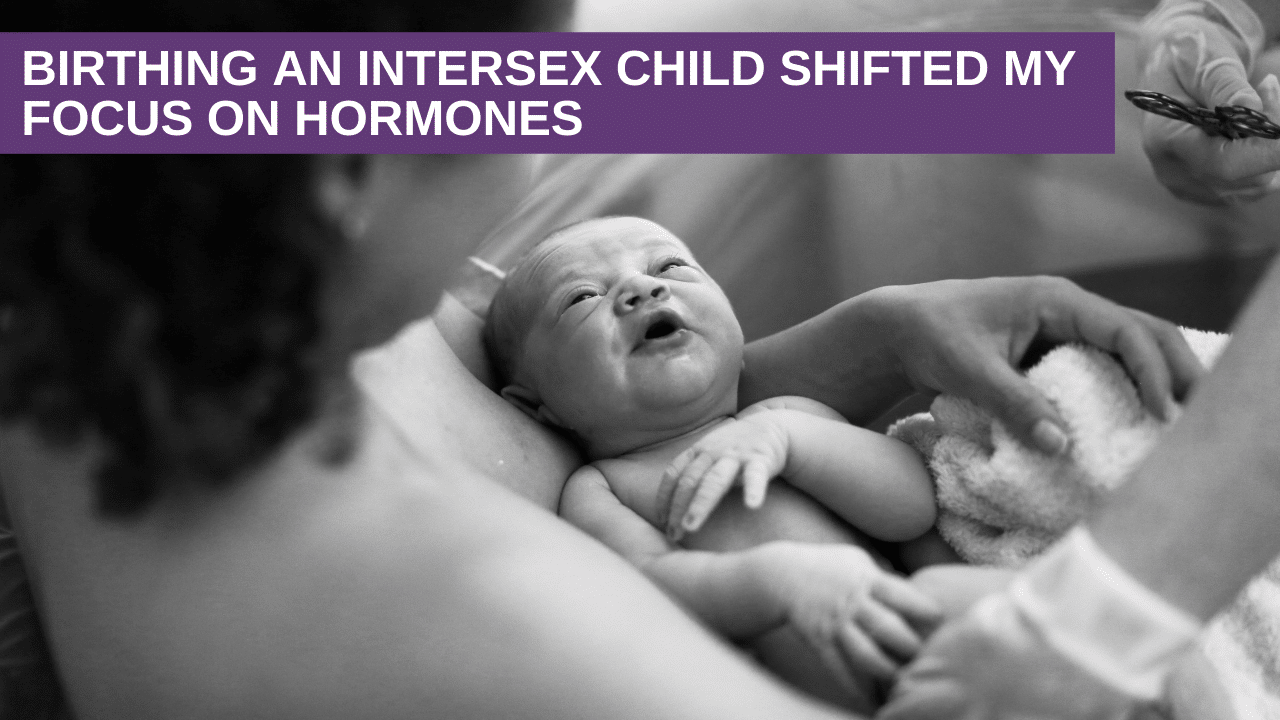
Birthing an Intersex Child shifted my Focus on Hormones

by Deborah Maragopoulos FNP | Oct 12, 2017 | Blog, Mind/Body | 0 comments

“Oh, my God, Deb!” On the verge of tears, my young husband is beside himself, “I don’t know how we’re going to afford all the care, the special schools!”

Special schools? Our baby is just hours old! I’m back in intensive care, hooked up to a myriad of IVs, being monitored. Steve’s been in the Neonatal Intensive Care Unit watching over our newborn. Reaching over the bed rail, I take his hand. “What is it?”

Barely taking a breath, he cries, “They said our baby will be deaf, blind, and mentally handicapped!”

“What? Who told you this? The intern?” I don’t even let him answer. “Does the baby have a rash, like this?” I show him my palm covered in a rash that looks like a blueberry muffin.*

He takes my hand. “Oh, no! You have rubella, too!” “That’s impossible! I’m immune so the baby is immune!” This is ridiculous. I need to speak to the chief neonatal resident. “Look, this is a reaction to the antibiotics they gave me. I’m allergic to penicillin. You’re allergic to penicillin. Our baby must be, too.”

My amniotic sac broke days before they finally let me deliver. That gave them time to give me steroids to try to get the baby’s premature lungs to develop. It worked; our baby can breathe on its own.

“There’s something else, Deb.” Steve leans heavily on the bed rail, exhausted, afraid, looking to me for hope. “They’re not sure if our baby is a boy or a girl.”

Steve and I meet with the pediatric endocrinologist. Our mothers come with us for moral support. The most renowned pediatric endocrinologist on the West Coast explains that our baby is an XY female, which means the chromosomes are male, but the genitalia appears female. Because it has androgen insensitivity, she recommends we raise it female.

The doctor says, and I quote: “It’s easier to make a hole than a pole.” I’m upset. This doesn’t feel right. “But what about our baby’s brain? If we raise him as a female and ‘she’ feels male, let’s say by adolescence, then won’t ‘she’ be psychologically confused and possibly damaged by adulthood?” “We don’t know, we only monitor them through childhood. We believe gender identity should match the genitalia and secondary sex characteristics.”

I’m just a neophyte nurse sitting in front of a renowned medical specialist, but her logic seems ludicrous.

Before I can argue the case of transgender individuals being surgically altered to suit how they feel about their gender identity right here at UCLA, my mother asks, “What’s secondary sex characteristics?” Like a good nurse, I explain the doctor’s medical jargon. “She means that if we raise our baby as a boy, he won’t have body or facial hair.”

Sitting up as tall as her four-foot ten-inch frame allows, Mom barks, “That’s ridiculous. The child is half Greek and half Italian. The women in our family have mustaches!” Mom’s protective energy reminds me of a small dog fending off a bear, “That’s no reason to cut off anything!”

So with the support of Mom, I follow my intuition against medical advice and go with our child’s DNA, knowing that he may decide later what gender best suited him (or her, or they...)

Our baby was born intersex.

Well, at least that’s the terminology used today. One in two thousand children are born with ambiguous genitalia. No one knows why. I know why I gave birth to an intersex child. Jarys is why I do what I do.

You see, I had to become a hormone specialist in order to save my child. And like Dorothy in the Wizard of Oz, I make the best of things. The tornado of birthing an intersex child and then navigating the medical system was a gift. Now it’s time to find the Yellow Brick Road.

Excerpt from Hormones in Harmony®

GG, SS, book

*Editor's note: literally a blue rash

Frequently Asked Questions:

Can your hypothalamus cause weight gain?

Yes. The hypothalamus is the master regulator of metabolism, controlling how your body stores and burns energy through its signaling to the thyroid, adrenals, and pancreas. When the hypothalamus becomes dysregulated by chronic stress, poor sleep, inflammation, or blood sugar instability, it defends a higher weight "set point" — causing the body to hold onto fat regardless of diet or exercise. This makes hypothalamic dysfunction an upstream root cause of stubborn weight gain.


What is a weight set point and why won't mine move?

A weight set point is the body weight your hypothalamus works to defend, calibrated over time by stress, sleep, hormones, and inflammation. When you diet, the hypothalamus perceives scarcity and responds by slowing metabolism, increasing hunger hormones, and suppressing satiety signals to return you to that set point. This is why most people regain lost weight within two to five years of conventional dieting — the set point itself was never recalibrated, only temporarily overridden.


Why do I gain weight under stress even when I'm not eating more?

Chronic stress raises cortisol, which disrupts blood sugar regulation, promotes abdominal fat storage, and signals the hypothalamus that the body is under threat. In survival mode, the hypothalamus defends fat stores and slows metabolism — so weight can increase even without any change in calorie intake. The stress chemistry, not the food, is driving the weight gain, which is why stress reduction is essential to any lasting metabolic reset.


Why do I regain weight after stopping GLP-1 medications?

GLP-1 medications work peripherally on appetite and gastric signaling, but they do not address the underlying hypothalamic dysregulation that sets your defended weight. Because the hypothalamic set point is never recalibrated, the body resumes defending its original weight once the medication stops — leading to significant regain. Long-term success requires restoring hypothalamic regulation so the set point itself lowers, rather than relying on appetite suppression alone.


How long does it take to reset your metabolism?

Genuine metabolic recalibration takes a minimum of 90 days, because the hypothalamus needs consistent signals of safety and sufficiency before it will lower its defended set point. This differs from a diet, which produces temporary suppression the body quickly corrects. A 90-day reset typically moves through three phases: stabilizing stress chemistry (days 1–30), rebuilding metabolic efficiency (days 31–60), and lowering the weight set point (days 61–90).


Why does my thyroid feel slow even though my labs are "normal"?

Under chronic stress, the body converts thyroid hormone into reverse T3, which blocks active thyroid receptors and slows metabolism at the cellular level — even when standard lab values appear normal. This means you can experience genuine symptoms of slow metabolism, such as fatigue, cold intolerance, and brain fog, while your thyroid panel looks unremarkable. Addressing the upstream hypothalamic and stress signaling often improves thyroid conversion and symptoms.


Is stubborn weight gain a willpower problem?

No. Stubborn weight gain is a signaling problem, not a willpower problem. The hypothalamus governs weight through survival mechanisms that operate below conscious control — defending its set point by slowing metabolism and increasing hunger when it perceives threat. No amount of discipline can override this system; lasting change comes from restoring hypothalamic regulation through reduced stress, balanced blood sugar, restorative sleep, and targeted nutritional support.

About the Author - Deborah Maragopoulos FNP

Known as the Hormone Queen®️, I’ve made it my mission to help everyone - no matter their age - balance their hormones, and live the energy and joy their DNA and true destiny desires. See more about me my story here...


Last Updated: April 14, 2022

0 Comments

Submit a Comment

Your email address will not be published. Required fields are marked *