
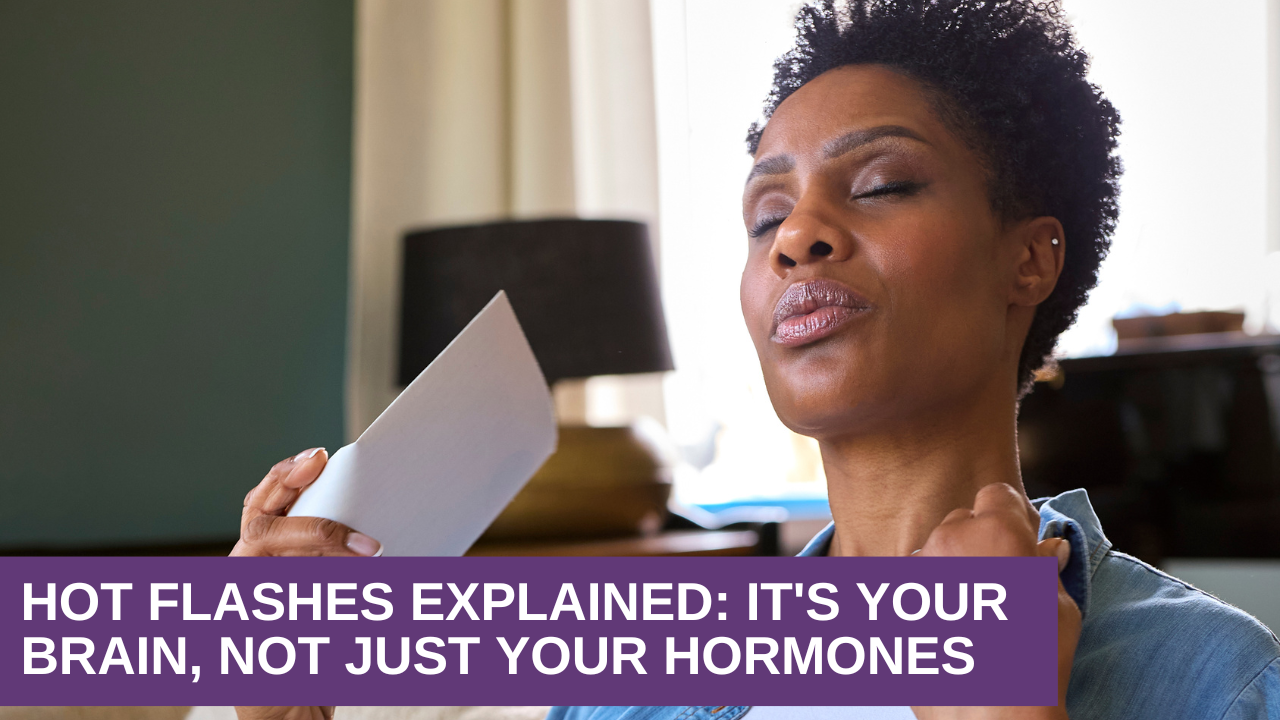
A hot flash doesn't start in your body. It starts in your brain — in a thermostat that has become oversensitive. And once you understand that, two things shift: the experience stops feeling so random and out of control, and a whole second lever opens up for addressing it.
Most of what women are told about hot flashes — "it's low estrogen, so replace the estrogen" — is incomplete. Estrogen is part of the picture. But the mechanism is in the brain, specifically in the hypothalamus, and understanding the brain-based mechanism is what gives you options beyond hormone replacement alone.
Meet Your Hypothalamic Thermostat
Your hypothalamus contains the body's primary temperature regulation center. Under normal conditions, it maintains a comfortable temperature zone — a range within which it does nothing except monitor. Nudge the system a little warm and it initiates cooling: blood vessels near the skin dilate, sweat glands activate. Nudge it a little cold and it initiates warming: shivering, increased metabolism, vasoconstriction.
This is elegant, automatic, and precise — when it works correctly.
Estrogen plays an important stabilizing role in maintaining that thermozone. With estrogen present at normal levels, the zone is wide enough that minor fluctuations in body temperature or environment don't trigger a response. As estrogen declines, that zone narrows — sometimes dramatically. What was once an easy fluctuation to ignore becomes a perceived emergency.
What a Hot Flash Actually Is
When the narrowed thermozone is breached — by any input your hypothalamus reads as "too warm" — the brain launches an aggressive heat-dumping response. Blood rushes to the skin's surface. Vessels dilate. Sweat glands fire. Heart rate rises. The body is doing exactly what it does when it needs to cool down rapidly.
The problem isn't the response itself. The response is functioning correctly. The problem is that the trigger threshold has become so sensitive that normal, minor inputs — a warm room, a glass of wine, a spike of emotion, a cup of coffee, a stressful moment — are being read as temperature emergencies that require an emergency response.
A hot flash is not your body malfunctioning. It's your thermostat working exactly as designed — but calibrated so sensitively that it calls a false alarm for almost any trigger. The goal is to recalibrate the thermostat, not just manage the alarms.
Why the Same Woman Has Very Different Experiences
Not every woman with declining estrogen has severe hot flashes. Some women have dozens a day; others have none. This variability is one of the clearest signals that estrogen alone doesn't explain the phenomenon.
The variables that most reliably predict hot flash frequency and severity map directly onto hypothalamic health:
• Chronic stress — the HPA axis and the temperature regulation center share hypothalamic territory and influence each other directly. Women under chronic stress have significantly more frequent and more severe hot flashes.
• Sleep quality — disrupted sleep raises central body temperature and disrupts the hypothalamic circuits that govern thermoregulation. It's bidirectional: hot flashes disrupt sleep, and poor sleep worsens hot flashes.
• Body composition — visceral adiposity is associated with increased hypothalamic neuroinflammation, which directly affects the sensitivity of the thermoregulatory center.
• Hypothalamic health — women with better-nourished, less inflamed hypothalami experience fewer and less severe hot flashes even at similar estrogen levels. This is consistent with decades of clinical observation and increasingly supported by mechanistic research.
The Triggers That Tip the Thermostat
Once you understand the sensitized-thermostat model, your personal triggers make sense. They're not random. Each one is something your hypothalamus reads as a warming input — and in a sensitized system, even mild warming inputs cause a disproportionate response.
Common triggers and why they work:
• Alcohol — dilates blood vessels and raises skin temperature; the hypothalamus reads it as a warming event.
• Caffeine — mild stimulant effects raise core temperature and activate the HPA axis.
• Emotional arousal — stress and strong emotions activate the hypothalamic-pituitary-adrenal axis, which is anatomically close to and functionally linked to the thermoregulatory center.
• Warm rooms — obvious, but the response is disproportionate because of the narrowed thermozone.
• Spicy foods — capsaicin directly activates thermal sensors; the hypothalamus responds as if body temperature has risen.
Tracking your triggers for one week — noting what preceded each flash — usually reveals a clear personal pattern. Most women have three or four primary triggers rather than an indiscriminate sensitivity to everything.
Two Levers, Not One
Most conversations about hot flash management focus on one lever: estrogen replacement. For many women, hormone therapy is appropriate, effective, and worth considering. But it is not the only lever, and for some women — those who cannot or choose not to use estrogen — it's important to understand the other one.
The second lever is the thermostat itself. Supporting hypothalamic function — reducing neuroinflammation, providing the specific nutrients the thermoregulatory center needs to widen its tolerance zone, lowering the chronic stress load that keeps the system sensitized — addresses the mechanism directly, not just the hormonal input.
Clinically, I have seen this make a meaningful difference. Women who support their hypothalamus consistently experience fewer hot flashes, less severe flashes, and a much wider window before triggers activate a response. Not elimination in every case — but calibration. The thermostat gets less touchy. The zone widens back out.
Where to Start
• Track your triggers for one week. The pattern will show you what to manage first.
• Lower your chronic stress load — this is the single biggest modifiable driver of thermostat sensitivity.
• Sleep in a cool, dark room. Your thermostat is most sensitive at night, and even small reductions in environmental temperature meaningfully reduce nighttime flashes.
• Support the hypothalamus with the specific nutritional inputs it needs to recalibrate — not just manage.
→ The free Hormone Reboot Training is built around calming the thermostat at the control-center level — so you're addressing hot flashes where they actually start, not just chasing them.

Frequently Asked QuestionS
What causes hot flashes?
Hot flashes start in the brain, not the body. Your hypothalamus contains the body's temperature-regulation center, which maintains a comfortable "thermoneutral zone." Estrogen helps keep that zone wide, so as estrogen declines in menopause, the zone narrows — sometimes dramatically. Once it's narrowed, normal inputs like a warm room or a spike of emotion can be misread as overheating, triggering the brain's rapid cooling response that you feel as a hot flash.
What actually happens during a hot flash?
During a hot flash, your brain launches an aggressive heat-dumping response because it has read some input as "too warm." Blood rushes to the skin's surface, blood vessels dilate, sweat glands activate, and heart rate rises — exactly what the body does when it genuinely needs to cool down fast. The response itself is working correctly; the issue is that the trigger threshold has become so sensitive that minor inputs set off this full emergency reaction.
Why do some women get hot flashes and others don't?
Because estrogen alone doesn't fully explain hot flashes. Two women with similar estrogen levels can have very different experiences, and the difference tracks with hypothalamic health. Chronic stress, poor sleep, and higher visceral body fat all increase the temperature center's sensitivity, while a better-nourished, less-inflamed hypothalamus tends to produce fewer and milder flashes. This is why hot flashes vary so widely from woman to woman.
What triggers hot flashes?
Common hot flash triggers are things your hypothalamus reads as warming inputs. Alcohol dilates blood vessels and raises skin temperature; caffeine mildly raises core temperature and activates the stress axis; emotional arousal activates the stress-response system linked to the temperature center; warm rooms push an already-narrowed comfort zone; and spicy foods activate thermal sensors directly. In a sensitized system, even mild versions of these cause a disproportionate response.

0 Comments