
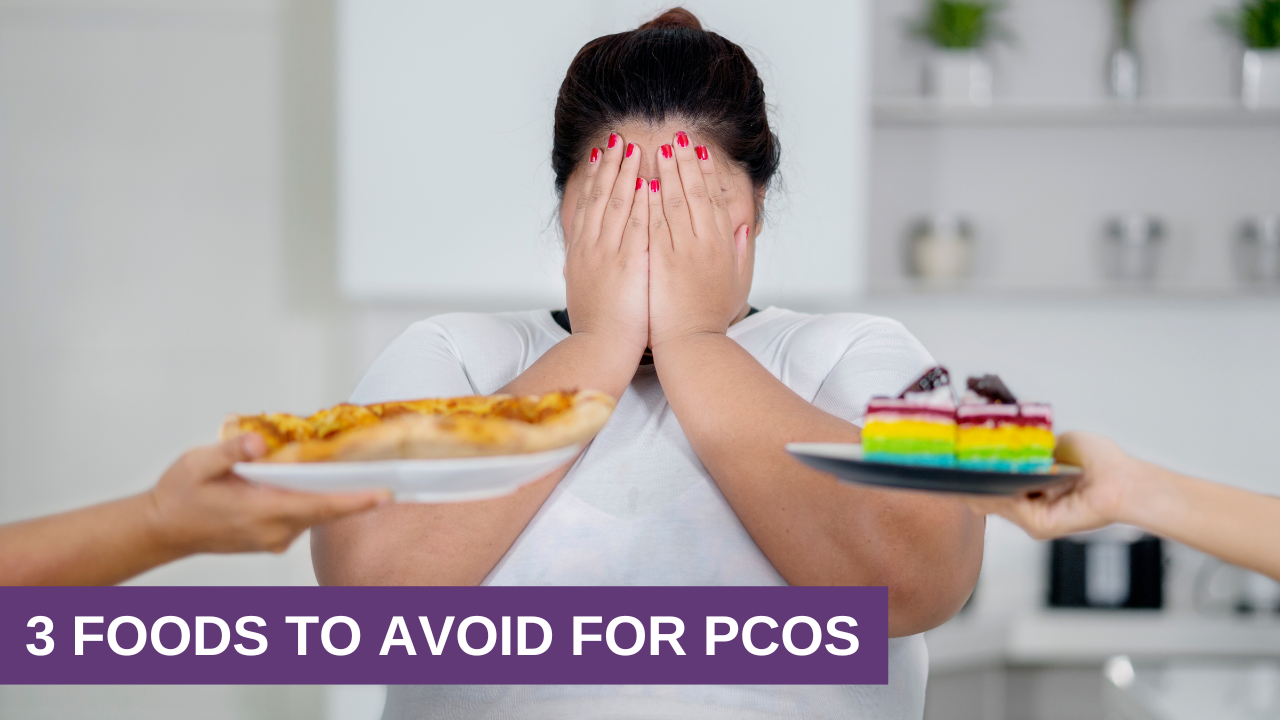
Today we’re going to talk about foods to avoid for PCOS and the best diet tips for PCOS.
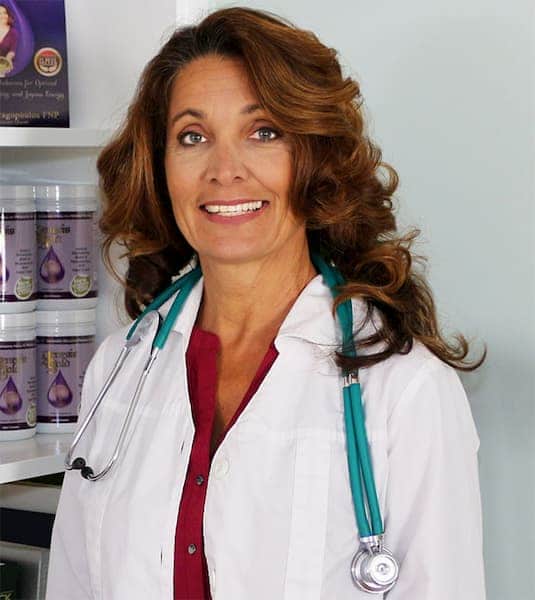
Hi, I’m Deborah Maragopoulos, FNP, intuitive integrative family nurse practitioner. I’m an expert in hormones, and I’ve helped many PCOS patients get their symptoms under control, as well as get pregnant, using dietary methods.
So the first thing I want you to understand is that PCOS is a metabolic syndrome causing insulin resistance.
That means the dietary tips for PCOS are all related to insulin-resistant diets.
#1: Foods to Avoid for PCOS:
You absolutely must avoid sugar in all forms, as well as sugars and starches.
When you decrease the amount of sugars and starches in your diet, and you are mostly eating proteins, fats, and vegetables, you are going to see a huge difference in your insulin sensitivity.
And as your insulin sensitivity improves, that can start to help control your PCOS symptoms.
What Foods Should You Avoid?
- Sugars in the form of baked goods, candies, and sweetened drinks.
- Starches in the form of flour, rice, potatoes, breads, and pastas.
Those are the foods you need to avoid. There are a lot of other alternatives, but what we are really talking about is an insulin-resistant diet.
#2: What Does an Insulin-Resistant Diet Look Like?
Breakfast:
Your breakfast should be rich in protein.
That may look like eggs.
You can also have plain yogurt.
You can have some fruit, some nuts.
And if you are having eggs, make sure you are adding some vegetables.
You also want to include some fat, maybe avocado.
Lunch:
For lunch, you want to make sure you are having protein and fat, and that your carbohydrates are coming from vegetables.
That may look like a salad with protein on it, nuts and seeds, and an olive oil dressing for fat.
You can have fish, chicken, or meat for protein.
Dinner:
Your dinner is going to be similar.
Maybe your vegetables are cooked, roasted, or sautéed.
That gives you a really good variety of vegetables, along with proteins and fats.
The key is avoiding the starches and sugars, especially if you are trying to bring insulin resistance down.
You can measure that through your fasting blood glucose, your hemoglobin A1C, and even by noticing how much fat you are pinching around your middle.
That is what I call your insulin meter. That makes a huge difference in controlling your PCOS symptoms.
#3: When You Eat Matters
It is not just what you eat; it is when you eat that counts.
One of the Best Dietary Tips for PCOS is this:
If you cannot avoid carbohydrates during the day, absolutely avoid them after dark.
When you eat carbohydrates after dark, your body is in storage mode.
Unless you are running a marathon, and you should not be doing that after dark, you are going to store those extra carbohydrates as fat.
All of those extra carbohydrates and that fat storage can increase your inflammatory markers, which is classic in PCOS.
So avoiding carbohydrates after dark can make a huge difference in your PCOS symptoms.
That includes starchy carbohydrates like pastas, potatoes, rice, and breads.
It also includes sugars, sweetened drinks, and alcohol.
If you need carbohydrates for energy, eat them earlier in the day.
Breakfast is the best time to have carbohydrates, such as oats, whole grains, or whole grain toast, so you can use that energy during the day.
Avoiding carbohydrates after dark can make a huge difference in your PCOS symptoms.
Remember What to Do
So remember, you are avoiding sugars and starches.
You are following an insulin-resistant diet that is rich in protein, fat, and vegetables.
And you are especially avoiding those carbohydrates after dark.
If you want to learn more, please sign up for my free Hormone Reboot Training.
0 Comments