

Hypothalamic Dysfunction Symptoms Across Eight Body Systems
The hypothalamus is the master regulator most conversations about chronic illness skip entirely — and it's the reason so many diagnoses cluster in the same patient.
If you've been collecting diagnoses for years — a thyroid panel here, a rheumatology referral there, an ADHD diagnosis in your forties, a hypermobility note nobody followed up on — you've probably had the same thought I hear from patients every week: these can't all be a coincidence.
They're not. And the reason they cluster is rarely obvious, because most specialists are trained to look downstream, at the organ or system that's failing, rather than upstream, at what's driving the failure in the first place.
In over three decades of clinical practice, the pattern I keep coming back to is this: when you trace enough overlapping symptoms far enough upstream, they keep pointing toward one small, almond-shaped structure at the base of the brain — the hypothalamus.
The Hypothalamus: Your Body's Master Regulator
The hypothalamus doesn't get the press that the thyroid, the adrenals, or the ovaries get. It doesn't have its own specialty. But it's the structure that tells all of those glands what to do.
It sits at the intersection of your nervous system, endocrine system, and immune system — which is exactly why dysfunction there doesn't stay contained to one system. The hypothalamus is responsible for:
- Neuroendocrine signaling — the hormonal cascades that regulate reproduction, stress, metabolism, growth, and the stress response (HPA axis)
- Autonomic balance — the push and pull between sympathetic (fight-or-flight) and parasympathetic (rest-and-digest) tone
- Immune activation — communication with the immune system via neuroinflammatory pathways
- Circadian rhythm — your internal clock, and the sleep-wake, hunger, and hormone cycles tied to it
- Thermoregulation — body temperature set-point and control
- Metabolism — mitochondrial function, glucose and fat storage, weight set point
- Mood and memory — the hypothalamus coordinates the neurotransmitters that govern both
- Gut and microbiome function — the hypothalamus orchestrates gastrointestinal function and microbiome communication
When this regulatory hub is overwhelmed — by chronic stress, unresolved infection, toxic burden, nutrient depletion, or genetic vulnerability — it doesn't fail quietly. It fails outward, into every system it governs. That's why hypothalamic dysfunction rarely presents as one diagnosis. In my patients, it often presents as several at once.
Eight Diagnoses, One Upstream Regulator
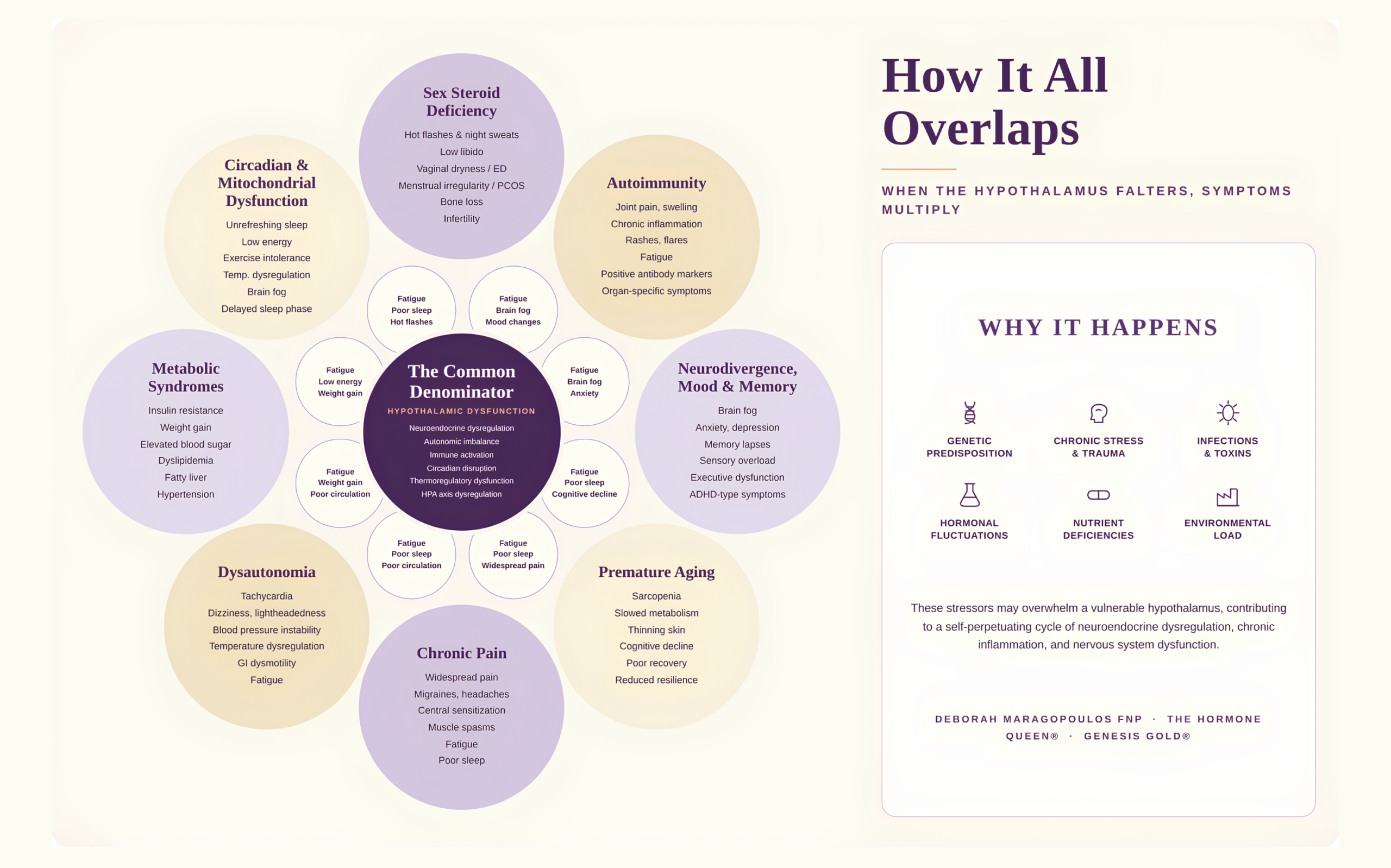
In my practice, these are the eight clusters I see returning again and again in the same patients — often treated by eight different specialists, with no one connecting the thread back to the hypothalamus.
1. Sex Steroid Deficiency
The hypothalamus governs the release of GnRH (gonadotropin-releasing hormone), which drives the entire reproductive hormone cascade. When hypothalamic signaling falters, so does everything downstream of it.
What it looks like: hot flashes and night sweats, low libido, vaginal dryness or erectile dysfunction, menstrual irregularities, PCOS, bone loss, infertility.
2. Autoimmunity
Chronic neuroinflammation may lower the threshold for immune dysregulation. The neuroimmune connection here is an active area of research, with studies describing a feedback relationship between HPA axis dysfunction and autoimmune flare patterns.
What it looks like: joint pain and swelling, chronic inflammation, rashes and flares, fatigue, positive antibody markers, organ-specific symptoms.
3. Neurodivergence, Mood, and Memory
The hypothalamus doesn't just regulate hormones — it regulates the neurochemical environment those hormones operate in. Disrupted circadian and stress signaling shows up directly as cognitive and mood symptoms.
What it looks like: brain fog, anxiety and depression, memory lapses, sensory overload, executive dysfunction, ADHD-type symptoms.
4. Premature Aging
Several of the major drivers of biological aging — chronic inflammation, oxidative stress, impaired recovery, mitochondrial decline — may be worsened by sustained neuroendocrine dysregulation. This is aging that outpaces the calendar.
What it looks like: sarcopenia, slowed metabolism, thinning skin, cognitive decline, poor recovery, reduced resilience.
5. Chronic Pain
Central sensitization — the nervous system's tendency to amplify pain signals — is increasingly understood as involving autonomic and neuroendocrine pathways, not musculoskeletal factors alone.
What it looks like: widespread pain, migraines and headaches, central sensitization, muscle spasms, fatigue, poor sleep.
6. Dysautonomia
The autonomic nervous system takes its cues directly from the hypothalamus. When that regulation breaks down, the result is a body that can't reliably manage heart rate, blood pressure, temperature, or digestion.
What it looks like: tachycardia, dizziness and lightheadedness, blood pressure instability, temperature dysregulation, GI dysmotility, fatigue.
7. Metabolic Syndromes
The hypothalamus is the body's primary energy-balance regulator, controlling hunger, satiety, and how efficiently you store versus burn fuel. Dysregulation here may act as an upstream contributor to metabolic disease, not only a downstream consequence of it.
What it looks like: insulin resistance, weight gain, elevated blood sugar, dyslipidemia, fatty liver, hypertension.
8. Circadian and Mitochondrial Dysfunction
The hypothalamic suprachiasmatic nucleus is your master circadian clock. When it's disrupted, sleep architecture suffers — and so may mitochondrial repair, much of which is thought to occur during deep sleep.
What it looks like: unrefreshing sleep, low energy, exercise intolerance, temperature dysregulation, brain fog, delayed sleep phase.
Where the Circles Overlap
This is the part that gets missed in a specialist-by-specialist approach: the symptoms that show up at the boundary between two categories are often the most diagnostically useful ones, because they're the clearest signal that you're not looking at eight separate problems.
Fatigue, brain fog, and poor sleep appear in nearly every overlap zone in my clinical mapping — not because they're vague, catch-all complaints, but because they're the most sensitive downstream markers of hypothalamic strain. If a patient in front of me has unexplained fatigue plus two or three symptoms from adjacent categories — say, hot flashes and poor circulation, or weight gain and cognitive decline — that combination is far more diagnostically meaningful than either symptom alone.
Why It Happens
Hypothalamic dysfunction doesn't appear out of nowhere. In the patients I see, it's almost always the downstream result of one or more of the following:
- Genetic predisposition — inherited vulnerability in stress-response or detoxification pathways
- Chronic stress and trauma — sustained HPA axis activation that never fully downregulates
- Infections and toxins — pathogens, mold, and environmental toxicants that provoke ongoing neuroinflammation
- Hormonal fluctuations — puberty, postpartum, perimenopause, and other transitions that stress-test the system
- Nutrient deficiencies — depleted cofactors the hypothalamus and its downstream pathways depend on
- Environmental load — cumulative exposure that outpaces the body's capacity to clear and repair
Individually, any one of these stressors might be manageable. Stacked together over years, they overwhelm a vulnerable hypothalamus and set off a self-perpetuating cycle: neuroendocrine dysregulation drives inflammation, inflammation drives further dysregulation, and the cycle deepens until it's expressing itself across nearly every system in the body.
A Note on What This Does and Doesn't Mean
Looking upstream doesn't mean your existing diagnoses are wrong, or that the care you're receiving for them isn't necessary. A thyroid condition still needs to be managed. An autoimmune diagnosis still needs monitoring. What I'm suggesting is an additional question to bring to the table — not a replacement for the treatment you're already getting. If anything, the patients who do best are the ones who keep their specialists in the loop while also asking what might be connecting the pieces.
The Takeaway
If you've been told your symptoms are "not connected," or you've been shuttled between specialists without anyone stepping back to look at the whole picture, it's worth asking a different question than the one you've probably been asking. Not what's wrong with my thyroid or what's wrong with my joints — but what's happening upstream that's driving all of this at once?
For many of the patients I see, that question leads back to the hypothalamus.
→ The free Hormone Reboot Training is the place to start — it shows you how to support the control center that runs desire, mood, sleep, and all of it. Link below.
You deserve to feel like yourself. The whole of yourself. Don't let anyone wave that off.

Frequently Asked Questions
What are the symptoms of hypothalamic dysfunction?
Hypothalamic dysfunction can produce symptoms across many body systems at once, because the hypothalamus regulates hormones, the stress response, temperature, metabolism, mood, sleep, the autonomic nervous system, and immune signaling. Common patterns include fatigue, brain fog, and poor sleep, along with symptoms like hot flashes, weight changes, mood changes, and temperature dysregulation. Because these cross multiple systems, they're often evaluated by different specialists separately. Persistent or unexplained symptoms should be assessed by a healthcare provider.
Why do my symptoms cross so many different body systems?
Because the hypothalamus sits at the intersection of the nervous, endocrine, and immune systems, dysfunction there doesn't stay contained to one area — it can express outward into every system it governs. This is one proposed explanation for why some patients accumulate several seemingly unrelated diagnoses over time. Rather than being unconnected coincidences, these may share an upstream regulator. It's a pattern worth discussing with a provider who can look at the whole picture.
Can the hypothalamus be the cause of multiple diagnoses?
It may be an upstream contributor. In clinical practice, some practitioners observe that conditions like sex-hormone deficiency, autoimmunity, mood and cognitive symptoms, chronic pain, dysautonomia, and metabolic issues cluster in the same patients. The proposed explanation is that hypothalamic dysregulation drives inflammation and hormonal disruption that ripple downstream. This is an area of ongoing research rather than settled fact, and it's meant to complement, not replace, evaluation of each individual condition.
What causes hypothalamic dysfunction?
Hypothalamic dysfunction is generally thought to develop from a combination of stressors stacked over time rather than a single cause. Proposed contributors include genetic predisposition in stress-response pathways, chronic stress and trauma, infections and environmental toxins, major hormonal transitions like perimenopause, nutrient deficiencies, and cumulative environmental load. Individually these may be manageable, but combined over years they can overwhelm the system. A provider can help identify which factors may apply to you.
Why are fatigue, brain fog, and poor sleep so common?
Fatigue, brain fog, and poor sleep appear across nearly every category of hypothalamic dysfunction, which is why they're so frequently reported. Rather than being vague or meaningless complaints, they may be among the most sensitive early markers of hypothalamic strain, because they reflect disruption in the circadian, metabolic, and neuroendocrine systems the hypothalamus coordinates. When they appear alongside two or three symptoms from other categories, the combination can be more informative than any single symptom.

0 Comments