

What decades of dieting never told you about the one master control center that decides whether your body holds fat or lets it go.
You have done everything they told you to do. You've counted the calories, tracked the macros, tried intermittent fasting, suffered through spin classes at 5 a.m., and maybe even considered — or tried — a GLP-1 medication. And still, your body holds on. The scale barely moves. Or it moves, and then the weight comes back — not as muscle, but as fat. And somewhere along the way, you began to wonder if something was wrong with you.
I want to say this as clearly and as gently as I can, after more than thirty years of clinical practice in neuro-immune-endocrinology: this is the heart of why hypothalamus weight gain is so misunderstood —
"You don't have a willpower problem. You have a signaling problem."
The weight that won't move isn't a character flaw. It isn't laziness or lack of discipline. It's your body doing exactly what it was designed to do — defending a set point that was shaped, over time, by stress, inflammation, sleep disruption, insulin resistance, thyroid dysregulation, or emotional survival patterns your nervous system learned long ago.
And that set point? It lives in one place.
Your hypothalamus.
The Command Center No One Talks About
Nestled deep in the center of your brain, about the size of an almond, the hypothalamus is the master regulator of your entire metabolic world. It is the upstream origin of nearly everything that governs how your body uses, stores, and burns energy.
When it's functioning well, it communicates in elegant, precise signals with your thyroid, adrenals, pancreas, gonads, and circadian clock. These systems talk to one another in a constant feedback loop, and your weight, your hunger, your energy — all of it — responds with intelligence.
When it's dysregulated — and in today's world, it very often is — those signals become garbled. The body stops reading the environment accurately. It perceives threat where there is none. And in response, it does what any survival system would do: it holds on.
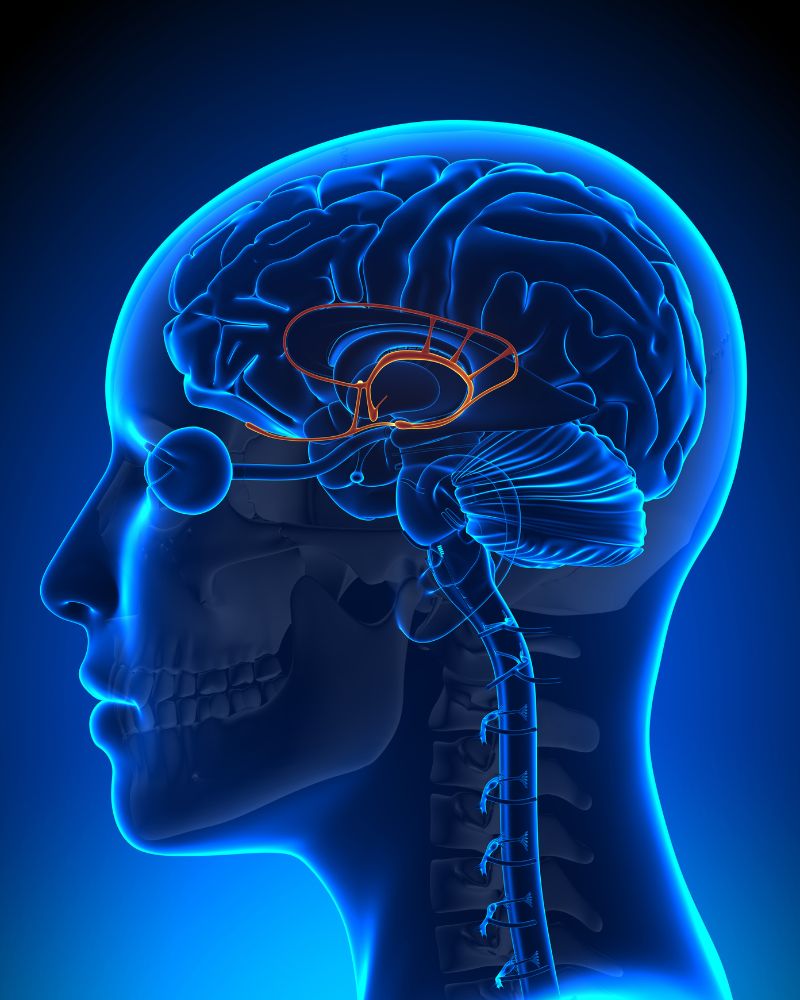
"Obesity is not a caloric math problem. It is a chronic neuroendocrine condition. It always involves hypothalamic dysfunction."
This is not a fringe opinion. This is the science that mainstream medicine has been slow to catch up to — and the framework that finally makes sense of why you can do everything "right" and still not see results.
What the Hypothalamus Is Actually Defending

Your hypothalamus is not being difficult. It's being loyal — loyal to a set point that was calibrated under conditions that no longer serve you.
When your body has been under chronic stress, your hypothalamus reads that as a signal of scarcity and danger. When you sleep poorly, your hypothalamus reads that as threat.
When blood sugar spikes and crashes unpredictably, when inflammation is high, when hormones are out of balance — the hypothalamus interprets all of it through one lens: survival.
And so it defends your weight. Not because you're broken. But because it's doing its job.
Here's what that looks like biochemically:
- Reverse T3 rises and blocks the active thyroid receptors, slowing metabolism at the cellular level
- Cortisol spikes — and then eventually crashes — disrupting blood sugar, sleep, and fat storage patterns
- Insulin resistance deepens, making cells progressively less responsive to metabolic signaling
- Hunger hormones like ghrelin surge while satiety signals like leptin are ignored
- Fatigue and cravings intensify — not as weakness, but as biologically appropriate responses to perceived stress
No amount of discipline will override this system. The hypothalamus is not in the department of willpower. It is in the department of survival. You cannot shame or starve it into cooperation. You must restore the communication.
Why Conventional Programs Don't Work Long-Term
Caloric restriction, appetite suppression, stimulant-based fat burners, extreme cardio — these approaches share a common flaw. They work downstream of the problem. They force the body into a temporary state that the hypothalamus immediately works to correct the moment the intervention stops.
This is why the research is so consistent: most people regain lost weight within two to five years of any conventional diet program. It's not failure. It's physiology. The hypothalamus won the argument.
Even GLP-1 medications — the most discussed pharmaceutical intervention of this decade — work peripherally on appetite and gastric signaling. They can be powerful tools. But without addressing the underlying hypothalamic dysregulation, the root cause remains. Many of my patients have experienced significant weight regain when GLP-1 medications are stopped, precisely because the set point was never recalibrated.
You cannot override the hypothalamic survival system with discipline. You must restore regulation.
This is the distinction that changes everything. Not working harder against your body — working with the system that governs it.
The 90-Day Metabolic Recalibration
What I have found, across decades of working with patients whose weight had stopped responding to everything else, is this: restoring hypothalamic regulation takes time. Real recalibration — not suppression, not temporary restriction, but a genuine shift in the set point — requires a minimum of 90 days.
This is not a diet. It is a metabolic reset from the top down, working with the body's own regulatory intelligence rather than against it.
It moves through three distinct phases:
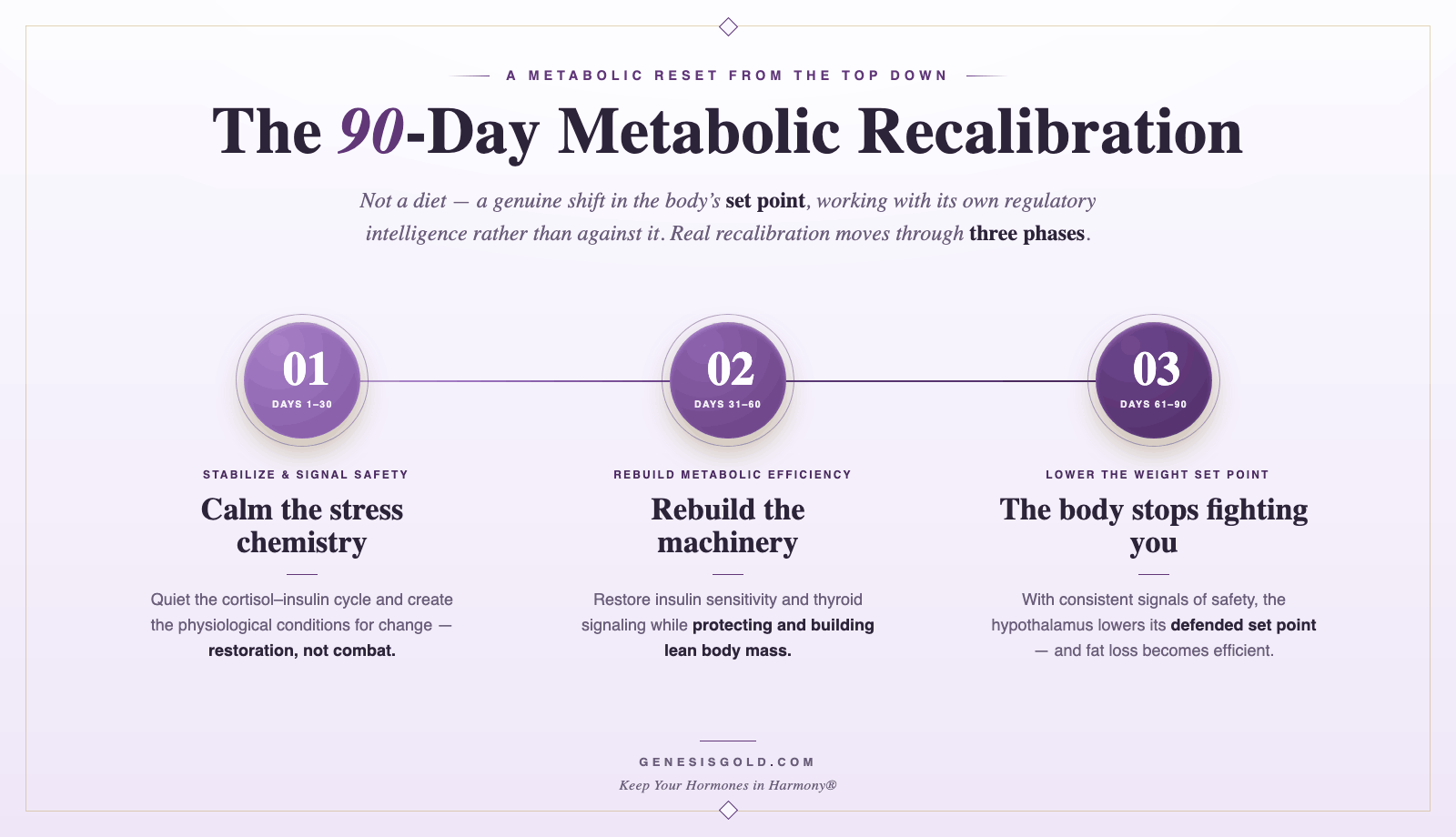
Phase One · Days 1–30: Stabilize & Signal Safety
The hypothalamus cannot begin to lower your set point while it still perceives threat. Phase One is about calming the stress chemistry, reducing metabolic chaos, and creating the physiological conditions for change.
- Hypothalamic nourishment with targeted amino acid and micronutrient support
- Blood sugar stabilization to interrupt the cortisol-insulin cycle
- Gentle detox support to reduce inflammatory load
- Sleep rhythm correction to restore circadian signaling
- No extreme restriction, no punishment workouts — this is restoration, not combat
What you may notice → more stable energy · reduced cravings · improved sleep · mental clarity returning
Phase Two · Days 31–60: Rebuild Metabolic Efficiency
With the nervous system calmer and cortisol beginning to normalize, the body becomes receptive to rebuilding the metabolic machinery — improving insulin sensitivity, supporting thyroid signaling, and protecting lean body mass.
- Insulin-resistant nutrition strategy that works with your unique biochemistry
Resistance training to preserve and build lean tissue - Strategic HIIT (when appropriate) to support mitochondrial efficiency
- Circadian reinforcement — eating and movement in alignment with your rhythms
- Continued hypothalamic support as the foundation
What shifts → reverse T3 begins to fall · body composition changes · waist circumference decreases · energy improves
Phase Three · Days 61–90: Lower the Weight Set Point
This is where genuine metabolic recalibration happens. The hypothalamus, now receiving consistent signals of safety and sufficiency, begins to lower its defended set point. The body is no longer fighting you.
- Consistent signaling through lifestyle, nutrition, and targeted supplementation
- Strength preservation and continued body composition shifts
- Nervous system resilience — the body's ability to adapt without threat responses
- Hormonal balance deepens across the entire neuroendocrine axis
What emerges → fat loss becomes more efficient · appetite self-regulates · mood stabilizes · metabolism feels online again
The Role of Genesis Gold®
Throughout all three phases, the foundational tool I use is Genesis Gold® — the supplement I formulated specifically to nourish the hypothalamus and restore neuroendocrine communication.
I want to be very clear about what it does and does not do, because the language around weight loss supplements is often misleading.
Genesis Gold® does not suppress appetite, force weight loss, overstimulate the metabolism, or create dependency. It is not a stimulant. It is not a shortcut.

What it does is provide the hypothalamus with what it needs to do its own job more effectively:
- Targeted amino acids to support neuroendocrine signaling across the entire HPA, HPT and HPG axes
- Micronutrients that assist thyroid and adrenal communication at the cellular level
- Phytonutrient density that reduces the inflammatory load that disrupts hypothalamic function
- Gentle metabolic activation that works with the body's own rhythms, not against them
When the hypothalamus is properly nourished and supported, the downstream systems — thyroid, adrenals, pancreas, gonads — begin to communicate with greater clarity. Insulin sensitivity improves. Thyroid conversion normalizes. Cortisol rhythms restore. Sex hormones rebalance. And weight, for the first time in years, becomes responsive again.
Is This the Right Path for You?
This approach is not for everyone. It requires patience, consistency, and a willingness to think differently about what weight loss actually means. It is not a 30-day quick fix. It is a recalibration.
You may be a good candidate for the 90-Day Metabolic Reset if:
- You have early insulin resistance (A1C between 5.6 and 6.4) or are at risk for metabolic syndrome
- You've plateaued despite eating well and exercising consistently
- You gain weight easily under stress — even when your intake hasn't changed
- Your thyroid labs come back "normal" but you feel metabolically slow, cold, or foggy
- You've tried diets, cleanses, or medications without achieving lasting results
- You want to lose fat without losing muscle — and keep it off for good
- You are currently on GLP-1 medication and want support for long-term metabolic restoration
What Success Actually Looks Like

I measure success differently than most programs.
Not by a number on a scale — which tells us almost nothing about metabolic health — but by the markers that actually matter.
- ⬇ Body fat percentage decreases
- ⬆ Lean body mass increases
- 📏 Waist circumference decreases
- 🩸 HbA1C and insulin markers improve
- ⚡ Energy and vitality return
- 🌙 Sleep quality improves
Metabolic health is about resilience — a body that can adapt, regulate, and maintain balance without constant intervention. That is what we are building. Not a temporary suppression of symptoms, but a genuine restoration of function.
You Are Not Lazy. You Are Not Broken.
The weight that won't move is not a verdict on your character. It is a signal from a system that needs support, not punishment. And when we address that system — the one at the very top of the chain — the rest of the body can finally follow.
Ninety days from now, you could still be frustrated, cycling through the same approaches that haven't worked. Or you could be metabolically recalibrated — with a body that is working with you instead of against you.
That is what I have spent thirty years helping people achieve. And it begins upstream.
Begin Your Weight Reset
90-Day Pathway
Restore communication. Lower your set point. Reclaim your metabolism — from the top down.

Subscribe & Save Benefits
- ✓ Save 10% on every order
- ✓ Free shipping for life
- ✓ Private community for insider guidance & support
- ✓ Weekly expert newsletters from Deborah
- ✓ Monthly live Q&A
- ✓ 90-day educational series
- ✓ Special anniversary gifts
- ✓ Priority customer service
Subscribe & Save Benefits
- ✓ Save 10% on every order
- ✓ Free shipping for life
- ✓ Private community for insider guidance & support
- ✓ Weekly expert newsletters from Deborah
- ✓ Monthly live Q&A
- ✓ 90-day educational series
- ✓ Special anniversary gifts
- ✓ Priority customer service

My question is, where is the assurance of where this is produced, is it FDA approved, is it compounded, what are the ingredients? This is a lot of language without a lot of substance. I believe the essence of what is being said as accurate, but there doesn’t seem to be any information about the exact product. Please advise or send me data
You can learn more about Genesis Gold here – https://genesisgold.com/genesisgold/ The ingredients are described in detail but also listed in this page where your comment was posted. Hope this helps.