
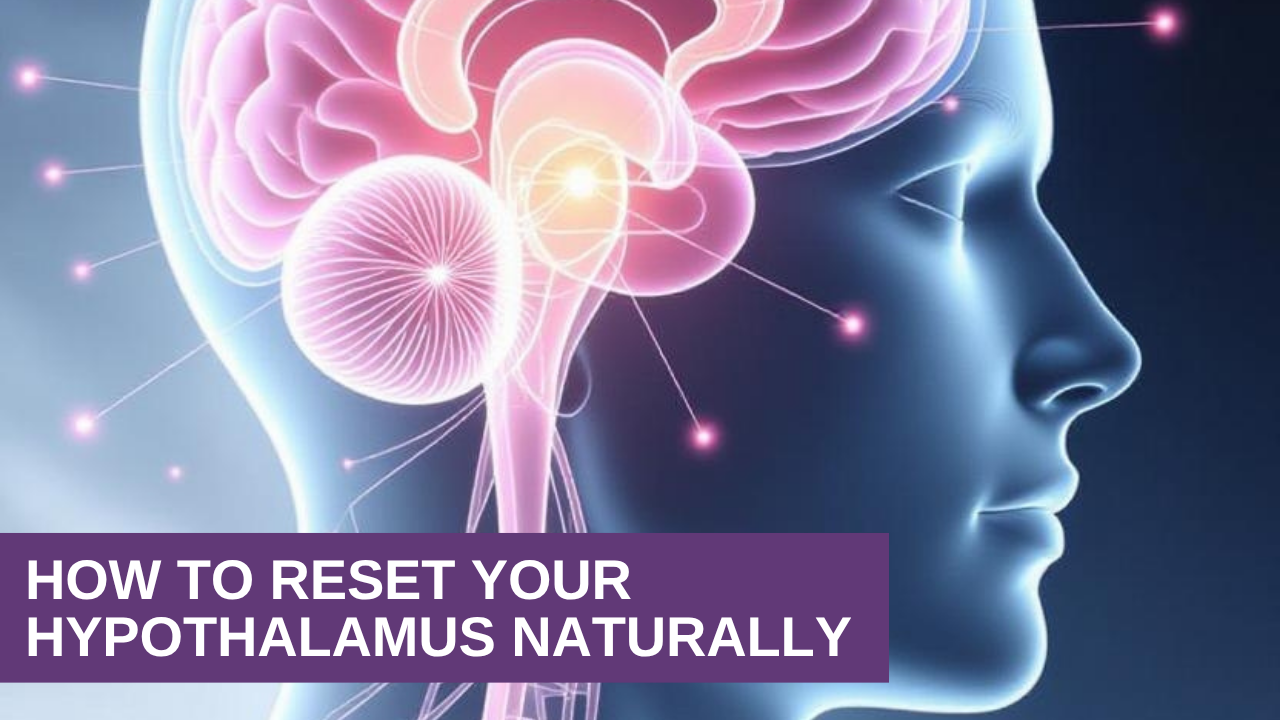
If your hypothalamus doesn't respond to force, it doesn't care how disciplined you are. It doesn't care how many supplements you take. It doesn't care about your willpower. It responds to one thing: safety. If you've been searching for how to reset your hypothalamus, naturally, what you're really asking is, "How do I make my body stop fighting itself?" And the answer is probably the opposite of what you've been told.
What Most People Get Wrong About Healing
I am Deborah Maragopoulos, FNP. I'm an integrative nurse practitioner. For over 30 years, I've worked with people who were doing all the right things. They were eating well, supplementing, exercising, addressing hormones, and still not healing. What I learned early on is this: the more aggressively someone tries to fix their body, the more their hypothalamus digs in.
Because the hypothalamus doesn't interpret effort, it interprets threat or support.
What “Reset Your Hypothalamus” Actually Means
Let's clear something up.
Reset Your Hypothalamus does not mean starving yourself, overdetoxing, overexercising, forcing hormone levels, or stimulating a stress system. The hypothalamus is a pattern recognition center.
It constantly tracks:
- blood sugar
- stability
- sleep-wake consistency
- neurotransmitter balance
- immune tone
- stress chemistry
- environmental exposure
- emotional load
When those inputs stabilize, the hypothalamus recalibrates on its own; that's what a real reset is, not intervention or restoration.
Why Pushing Harder Backfires
Now, this is the part I wish I could tell every person before they start another extreme protocol. This is why I see people crash after fasting too hard, doing extreme cleanses, taking stimulating adaptogens, and or stacking more and more supplements.
To a dysregulated hypothalamus, stimulation equals danger.
So instead of healing, it raises cortisol, raises prolactin, disrupts thyroid conversion, blocks hormone receptors, suppresses metabolism, fragments sleep, and people walk away thinking: "My body just can't heal."
But that's not true.
Your body just didn't feel safe.
What Actually Works
So if forcing doesn't work, what does?
Here's what the research and my 30 years of clinical experience point to.
Your hypothalamus isn't broken. It's protective. And once it sends its predictable nourishment, gentle neuroendocrine support, stable circadian cues, and reduced inflammatory noise, it releases the break.
Practically, this means:
Eating consistently, not skipping meals, and not extreme restriction.
Your hypothalamus tracks blood sugar as a survival signal. Chaotic eating tells it food is scarce.
Sleeping and waking at predictable times.
Your hypothalamus sets your internal clock. Irregular rhythms confuse it.
Reducing inflammatory inputs, processed foods, environmental toxins, and chronic emotional stress.
These all register as a threat.
And providing the raw materials the hypothalamus needs for signaling — specific amino acids, minerals, phytonutrients (not mega doses, not random stacks). Balanced, consistent, gentle input.
Healing resumes when the body stops bracing.
Why Healing Takes Time
This is the part that marketing skips.
Hypothalamic regulation happens in layers. Subtle shifts around 30 days. Clearer signals by 60. Real stability closer to 90 days.
Not because you're slow, but because your biology needs repetition to trust.
Think about it.
If your body has been in survival mode for years. One good week doesn't prove anything. 90 consistent days begins to.
This is why everything I teach starts with regulation, not stimulation.
Where to Start
If you want to understand this process step by step, I created a free Hormone Reboot Training that explains hypothalamic healing in a way doctors were never taught.
You don't need more discipline.
You don't need more willpower.
You need the right signals, and your body knows exactly what to do once it receives them.

0 Comments